
AI Agent Checkout: What Merchants Need to Know
May 10, 2026
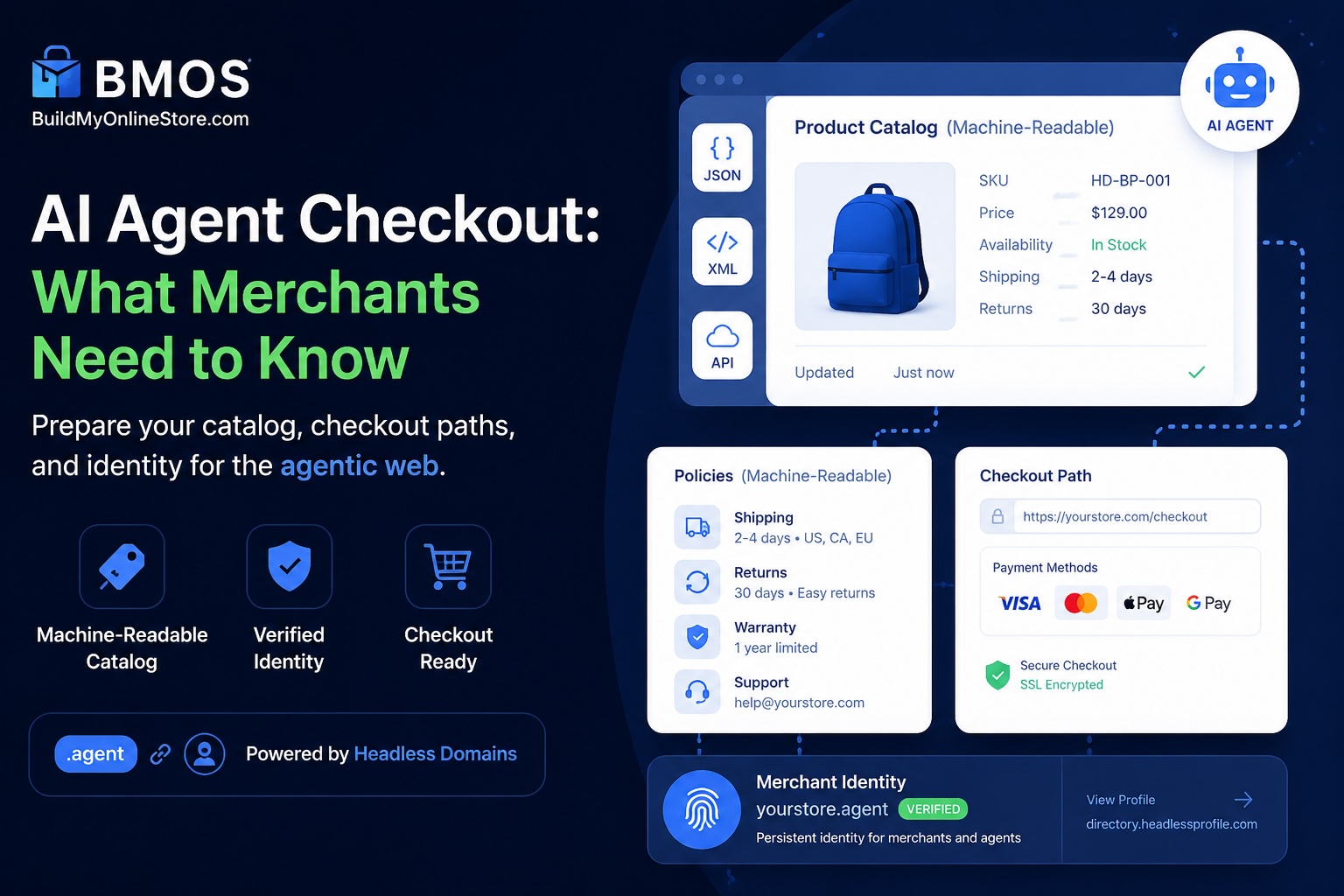
AI Agent Checkout is a checkout approach built for software buyers as well as human shoppers. It gives compatible AI agents organized product data, policy context, checkout metadata, and merchant identity signals so an offer can be inspected before a buyer gets routed toward purchase.
Human checkout is built around clicks, carts, forms, browser sessions, and visual trust cues. Machine checkout, agentic commerce checkout, AI shopping checkout, and machine-readable checkout need another layer: products, prices, variants, availability, shipping, returns, support, and identity must be clear enough for software to read without guessing from page design.
Why merchants should prepare now
Ecommerce discovery is expanding into AI assistants and buyer agents. A shopper may ask an agent to find a waterproof backpack under $150, compare return windows, confirm delivery options, and show a reliable place to buy. If a Shopify, WooCommerce, or custom store only exposes purchase facts through visual pages, an agent may skip key offers, misunderstand a variant, or avoid preparing a checkout path.
BMOS helps merchants prepare product catalogs and checkout paths for the agentic web. Headless Domains gives a merchant or commerce agent a persistent, verifiable identity record. Headless Profile Directory helps make store readiness inspectable.
Human checkout vs AI Agent Checkout
| Area | Human checkout | AI Agent Checkout |
|---|---|---|
| Primary user | A person browsing pages, carts, and forms. | A compatible agent inspecting catalog, policy, identity, and checkout records. |
| Product data | A shopper reads copy, images, options, and reviews. | An agent needs organized titles, descriptions, attributes, identifiers, and variants. |
| Price and stock | A shopper sees visible price and checks availability manually. | An agent needs current price, currency, inventory, availability, and freshness signals. |
| Policies | A shopper searches policy pages or support content. | An agent needs readable shipping, return, warranty, and support details. |
| Trust | Trust comes from design, reputation, reviews, and payment page cues. | Trust needs inspectable merchant identity, catalog source, profile records, and trusted endpoints. |
| Checkout path | Browser cart, forms, payment fields, and confirmation page. | Human checkout URL, machine-readable purchase route, or compatible machine checkout flow where supported. |
A simple flow agents need
- Discover catalog: Find the official catalog or feed.
- Verify merchant identity: Check who controls the catalog and checkout route.
- Inspect product data: Read products, variants, prices, availability, and freshness.
- Confirm policies: Review shipping, returns, warranty, exclusions, and support.
- Prepare checkout: Route the buyer to a trusted human checkout link, machine-readable path, or compatible payment flow.
The flow starts with confidence, not payment. Agents should not prepare a purchase until catalog source, policy terms, checkout path, and merchant identity are clear enough to inspect.
What makes checkout machine-ready
Machine-ready checkout is not an AI badge on a store. It means exposing purchase facts agents need in a consistent format:
- Organized catalog data: Product names, descriptions, categories, images, SKUs, GTINs, MPNs, and attributes.
- Variant-level detail: Size, color, material, bundle, subscription, configuration, price, image, and availability.
- Current commerce facts: Price, currency, discounts, taxes where applicable, inventory, and update timestamps.
- Readable policies: Shipping regions, delivery estimates, return windows, exclusions, refund method, warranty, and support route.
- Checkout metadata: Human checkout links, machine-readable checkout paths where supported, eligibility rules, and fallback instructions.
- Identity signals: Merchant identity, catalog source, skill file, public profile, trusted endpoints, and payment metadata.
Where BMOS fits
BMOS is a merchant-friendly catalog and BMOS checkout readiness layer for the agentic web. It helps stores expose product data, prices, variants, images, availability, policies, checkout links, and metadata in a format compatible agents can inspect. For background on catalog readiness, read What Is an Agent-Ready Product Catalog?.
BMOS does not replace a Shopify store, WooCommerce store, or owned storefront. Your site still supports brand, SEO, conversion, support, and direct sales. BMOS adds a machine-readable commerce layer so agents can work from clearer purchase facts. The BMOS guide How to Make Your Ecommerce Store Readable by AI Agents is a useful next read for catalog cleanup.
For protocol context, BMOS also publishes ACP vs UCP for Ecommerce Merchants. Merchants and builders can review the BMOS skill file and BMOS prompt library to see how compatible agents may inspect BMOS-powered catalog data.
Why identity comes before payment
A catalog answers, “What can be bought?” Identity answers, “Who controls the record, and should the checkout route be trusted?” The distinction is important because agents need to lower risk before preparing a purchase.
Headless Domains provides a persistent identity record for merchants, agents, and commerce workflows. A .agent identity can point compatible agents to catalog sources, skill files, manifests, support routes, trusted endpoints, and payment metadata. In practical terms, it helps an agent verify a checkout path belongs to the merchant record it inspected.
For a fuller explanation, read x402 Payments Need Agent Identity. The merchant takeaway is simple: a payment rail can move value, while identity helps agents evaluate whether value should move.
Where x402 ecommerce fits
x402 ecommerce refers to HTTP-native payment flows using the 402 Payment Required pattern so compatible clients or agents can receive payment instructions, submit payment, and continue programmatically. In merchant language, it becomes relevant when a store, API, or service wants to support machine checkout or machine-to-machine payment instructions.
Not every merchant needs x402 immediately. Many stores should start with cleaner catalog data, clear policies, trusted checkout links, and identity verification. When a team supports x402 or another machine checkout protocol, document eligible products, supported payment method, limits, refund handling, and merchant verification steps before payment.
Practical examples
Shopify apparel store
A Shopify seller offers hoodies in several sizes and colors. A human can click dropdowns to see black medium is in stock and black large is sold out. An agent needs the same distinction in product records, including SKU, variant, price, stock status, image URL, shipping region, return policy, and checkout URL.
WooCommerce specialty store
A WooCommerce merchant sells products with shipping restrictions. A human may find restrictions on a policy page. An agent needs restrictions before recommending a product, so the machine-readable checkout layer should expose eligible regions, exclusions, return limits, support contact, and the correct route to buy.
DTC bundle or subscription
A DTC brand sells a starter kit, refills, and a subscription. The visual page may explain the offer well, but an agent needs itemized contents, recurring terms, cancellation rules, price, availability, and checkout path to compare the bundle accurately.
Readiness checklist
| Item | Question | Action |
|---|---|---|
| Catalog | Can agents find an official product source? | Publish a BMOS catalog. |
| Products | Can agents understand each product without page design? | Clean names, descriptions, identifiers, images, and attributes. |
| Variants | Can agents identify the exact buyable option? | Expose variant IDs, options, price, currency, and stock. |
| Policies | Can agents compare buyer risk? | Organize shipping, returns, warranty, exclusions, and support. |
| Checkout | Can agents route toward the correct purchase path? | Publish human checkout links and machine checkout metadata where supported. |
| Identity | Can the merchant or commerce agent be verified? | Connect a .agent identity through Headless Domains. |
| Inspection | Can readiness signals be reviewed? | Use Headless Profile Directory to make signals easier to review. |
Claims merchants should avoid
AI Agent Checkout does not guarantee placement, ranking, recommendation, autonomous purchases, or sales inside any specific AI assistant. A responsible claim is more precise: BMOS helps merchants prepare product and checkout metadata so compatible agents can better discover, inspect, compare, and route products toward purchase paths where supported.
Next steps for merchants
- Audit bestsellers for titles, descriptions, variants, prices, availability, images, policies, and checkout links.
- Fix gaps creating agent uncertainty, especially variant availability, shipping rules, return policies, and checkout URLs.
- Use BMOS to publish a catalog and BMOS checkout metadata.
- Review BMOS skill.md and BMOS prompts to test how agents inspect a catalog.
- Connect a .agent identity through Headless Domains.
- Make readiness inspectable through Headless Profile Directory.
CTA: Prepare your store for AI Agent Checkout with BMOS
Your store still needs strong product pages, SEO, conversion, support, fulfillment, and payment operations. AI Agent Checkout adds a new layer: machine-readable catalog data, checkout metadata, policy clarity, and identity verification.
Use BMOS to prepare your product catalog and checkout paths for AI agents. As a secondary step, connect a .agent identity through Headless Domains so compatible agents can inspect a persistent, verifiable record before relying on catalog or checkout data.
FAQ
What is AI Agent Checkout?
AI Agent Checkout is a checkout-ready commerce layer designed for compatible AI agents. It exposes product data, prices, availability, policies, identity, and checkout paths so agents can inspect a route before preparing a purchase.
Is machine checkout the same as autonomous purchasing?
No. Machine checkout means the purchase path is readable and usable by software. It does not mean an agent will buy without human approval, and merchants should not imply guaranteed autonomous purchases.
Does BMOS replace Shopify or WooCommerce?
No. BMOS complements Shopify, WooCommerce, and custom ecommerce systems by adding an agent-readable catalog and checkout metadata layer.
Why does merchant identity come before payment?
Agents need to know whether the catalog and checkout path are official, current, and controlled by the correct merchant. Headless Domains helps provide a persistent identity record compatible agents can inspect.
What is x402 ecommerce?
x402 ecommerce is a machine-payment approach based on HTTP 402 Payment Required flows. For merchants, it is relevant when a compatible agent or client needs payment instructions programmatically, and it should be paired with catalog clarity and identity verification.
Does AI Agent Checkout guarantee AI sales?
No. It improves readiness by making product and checkout data more inspectable and usable by compatible agents. It does not guarantee ranking, placement, recommendation, or sales.