
What Is an Agent-Ready Product Catalog?
May 6, 2026
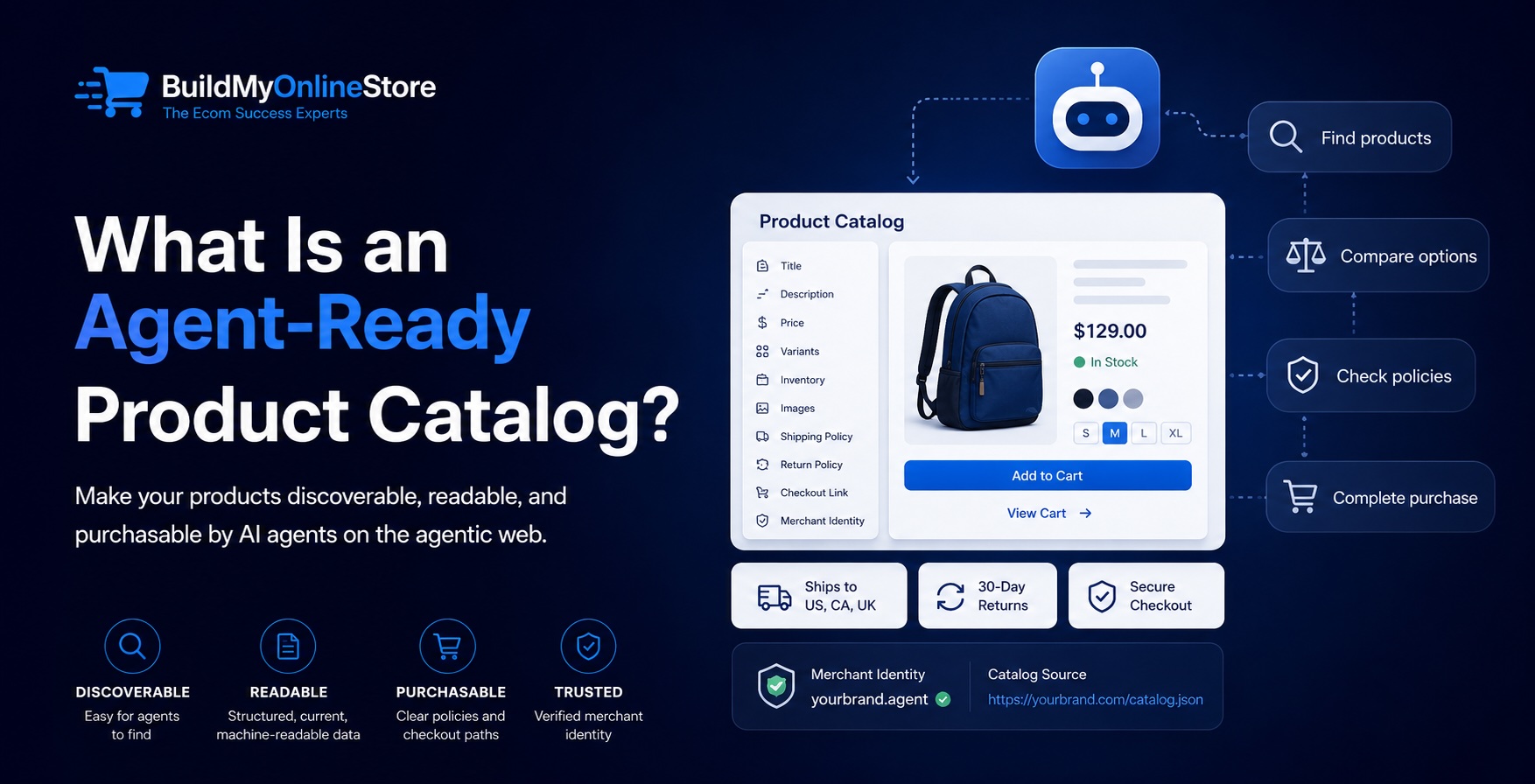
An agent-ready product catalog is a structured, current, machine-readable version of your ecommerce catalog that AI agents can discover, parse, compare, and use in commerce workflows.
That sounds technical, but the merchant problem is simple: your store was probably built for humans and search engines. The next commerce channel is different. Buyers are beginning to ask AI shopping agents to find products, compare options, check constraints, review policies, and help complete purchases. Those agents need product data they can trust and act on.
BMOS is the merchant-friendly product catalog layer for the agentic web. It helps merchants publish an agent-readable commerce catalog so products can become discoverable, readable, and purchasable by compatible AI agents.
This does not mean BMOS guarantees placement inside ChatGPT, Claude, Gemini, or any specific AI shopping agent. It means BMOS helps merchants prepare their product data for the systems, agents, and workflows that can read structured catalogs and act on compatible commerce records.
What is an agent-ready product catalog?
An agent-ready product catalog is a commerce feed designed for software buyers, not only human shoppers. It gives AI agents the structured facts they need to understand what you sell, whether it is available, how it varies, what it costs, where it ships, how returns work, and how a purchase can be routed.
A normal ecommerce page says, “Here is a product page a person can read.”
An agent-ready product catalog says, “Here is the product data an agent can safely inspect, compare, and use.”
That difference matters because AI agents do not shop like people. A person can scroll through photos, read marketing copy, click size selectors, open a shipping page, search for a return policy, and make a judgment. An agent needs the same information in a cleaner format.
At minimum, an agent-ready catalog should expose:
- Product title
- Product description
- Price and currency
- Variants such as size, color, bundle, subscription, or configuration
- Inventory and availability
- Product images
- Category and product identifiers where available
- Shipping policy
- Return policy
- Checkout links
- Merchant identity and trust signals
- Freshness metadata so agents know whether the data is current
This is why an AI product catalog is not just a prettier product feed. It is a practical operating layer for agentic commerce.
Why normal ecommerce pages are not enough
Most ecommerce stores have product pages, category pages, navigation menus, filters, checkout flows, and policy pages. Those are still important. Humans still need a storefront. Search engines still need crawlable pages. Brand, design, trust, photography, and conversion copy still matter.
But AI shopping agents need a different surface.
A product page built for a person often hides critical information across several places. Price may update through JavaScript. Variants may live inside selectors. Shipping details may be in a separate policy page. Return rules may be written in long legal copy. Inventory may be visible only after a shopper picks a size. Checkout may require several browser steps.
That is manageable for a human with patience. It is fragile for an agent trying to answer a buyer’s request accurately.
The Headless Domains article Welcome to the Post-Browser Web explains the bigger shift: websites are not disappearing, but agents increasingly need structured data, trusted endpoints, policies, profiles, and identity records to act on behalf of users. For ecommerce, that means your store should not only be browsable. It should also be legible to agents.
Human ecommerce page vs SEO product page vs agent-ready product catalog
| Commerce surface | Primary audience | What it optimizes for | What agents still need |
|---|---|---|---|
| Human ecommerce page | Shoppers browsing your site | Visual persuasion, product education, brand trust, conversion | Clean structured data, machine-readable policies, current availability, direct action paths |
| SEO product page | Search engines and shoppers from search | Indexing, rankings, snippets, product rich results, organic traffic | Agent-readable checkout, identity records, catalog-level consistency, structured comparison data |
| Agent-ready product catalog | AI shopping agents, buyer agents, commerce tools, technical marketers | Discoverability, readability, comparison, policy inspection, purchase routing | Ongoing feed freshness, compatible agent access, trusted merchant identity, clear permissions |
How an AI shopping agent uses a product catalog
Imagine a buyer asks an AI assistant:
Find me a black waterproof backpack under $150, make sure it ships to Austin, check the return policy, and show me the best option.
A human shopper might search Google, open several tabs, compare product pages, read reviews, check shipping, and then decide. An AI agent needs to perform a similar workflow with structured inputs.
For the agent, the best catalog entry is not only a product description. It is a complete decision object. It should answer questions like:
- What is the product?
- Who sells it?
- What does it cost right now?
- Is the requested variant available?
- Can the item ship to the buyer’s location?
- What happens if the buyer returns it?
- Is the merchant identity inspectable?
- Where should the agent send the buyer to complete checkout?
That is the practical meaning of an agentic commerce catalog. It helps agents move from vague product discovery to structured product evaluation.
Schema.org helps, but it is not the whole layer
Schema.org Product markup is useful. Search engines and other systems can use structured data to better understand product pages. Google’s product structured data documentation also highlights important ecommerce details such as price, availability, variants, shipping, and returns.
Merchants should not ignore Schema.org. It remains valuable for search visibility and product interpretation.
But Schema.org alone is not the full agentic commerce layer.
Why? Because agents may need more than page-level markup. They may need catalog-level access, current feed data, checkout paths, merchant identity records, policy metadata, payment compatibility, and instructions for how to resolve the correct source of truth. A product page can contain structured data, but an agent-ready catalog gives agents a cleaner path to use the product data in a workflow.
Think of Schema.org as one important vocabulary. Think of BMOS as a merchant-friendly way to publish an agent-readable catalog that compatible agents can discover and use.
What BMOS adds for merchants
BMOS helps merchants create a structured catalog layer for AI commerce without asking every store owner to become a protocol engineer.
With BMOS, merchants can build or connect a catalog, publish structured product data, and expose the information agents need to understand what is available. BMOS is designed around the practical merchant problem: make products easier for compatible AI agents to discover, read, compare, and route toward purchase.
The BMOS skill file gives agents instructions for discovering BMOS-powered catalogs, resolving merchant records, fetching the live catalog feed, and using current product information. The BMOS prompt library gives merchants and builders copy-paste prompts for testing how compatible LLMs and agents inspect BMOS catalog data.
For merchants, the value is straightforward:
- Discoverable: Agents need a known place to find your catalog.
- Readable: Agents need structured data rather than guessing from page design.
- Comparable: Agents need normalized fields for price, variants, policies, and availability.
- Purchasable: Agents need checkout links or purchase routing instructions that match the merchant’s workflow.
- Inspectable: Humans and agents need ways to verify the merchant and catalog source.
Where Headless Domains fits
BMOS is the product catalog layer. Headless Domains is the persistent identity layer.
In agentic commerce, identity matters because agents and merchants need trusted records that can be inspected outside a single marketplace, app, or chat session. A .agent identity can point compatible agents to the merchant’s trusted catalog source, skill file, profile, and other machine-readable records.
In plain language: BMOS can help structure the catalog, while a .agent identity can help agents know where that catalog lives and who it belongs to.
The Headless Domains article AI Just Created a New Ecommerce Org Chart explains why merchants now need to think about product data, machine-ready checkout paths, identity records, trust signals, and AI-agent discoverability. That is the operating model BMOS is built to support.
Where Headless Profile Directory fits
Headless Profile Directory is the inspection and discovery layer for agentic identities. It gives humans and agents a place to inspect identity records, commerce readiness signals, and related profile data.
For ecommerce merchants, that inspection layer matters because agentic commerce should not become a black box. A buyer, builder, agency, or agent should be able to inspect whether a merchant has a readable profile, a connected catalog, and records that point to the right source of truth.
That does not replace your store. It complements it. Your ecommerce site remains your storefront. BMOS provides the catalog layer. Headless Domains provides identity. Headless Profile Directory helps make readiness easier to inspect.
Practical examples of agent-ready catalog data
Example 1: A Shopify merchant selling apparel
A Shopify seller has product pages for shirts, hoodies, and hats. Human shoppers can pick sizes and colors on the storefront. An agent, however, needs the variant data in a structured format.
An agent-ready BMOS catalog should make it clear that the black hoodie comes in small, medium, large, and extra large, with a current price, image, stock status, return rules, and checkout URL for the correct variant.
Without that structure, an AI shopping agent may have to infer too much from the product page. With the structure, the agent can answer a buyer more accurately.
Example 2: A WooCommerce merchant selling specialty products
A WooCommerce store sells products with shipping restrictions. A human may eventually find those restrictions on a policy page. An agent needs those restrictions before recommending the product.
An agent-ready catalog can expose shipping regions, return limits, delivery constraints, and product availability in a format the agent can parse. That reduces the chance that an agent recommends a product the buyer cannot actually receive.
Example 3: A DTC founder selling bundles
A DTC brand sells a starter kit, refills, and subscriptions. The website explains the value visually, but an agent needs to compare the offer against alternatives.
The BMOS catalog can help describe the bundle, included items, price, recurring terms if applicable, return policy, and checkout path. That makes it easier for a buyer agent to answer, “Which option is best for my budget and usage?”
What should merchants prepare before publishing an agent-ready catalog?
You do not need a perfect enterprise data operation to get started. You do need clean product facts.
Before publishing your BMOS catalog, review these fields:
- Product names: Use clear names that describe the product, not only branded internal names.
- Descriptions: Explain what the product is, who it is for, and what is included.
- Prices: Keep price and currency current.
- Variants: Make size, color, material, bundle, and subscription options explicit.
- Images: Provide stable image URLs where possible.
- Inventory: Make availability clear so agents do not recommend out-of-stock items.
- Shipping: State shipping regions, estimated timing, and restrictions.
- Returns: State return windows, exclusions, and refund conditions.
- Checkout: Provide clean checkout links or purchase routing instructions.
- Identity: Connect your catalog to a trusted merchant or .agent identity where appropriate.
If you are still building your store foundations, BMOS also has useful merchant education resources such as the Complete Guide To Starting Your Online Store, which covers product preparation, ecommerce platforms, and product setup. If you are reviewing how customers move through your store, read The Anatomy Of An E-Commerce Sales Funnel. If checkout readiness is your priority, the BMOS article on online payment methods for ecommerce stores is a useful companion.
How agencies and technical marketers should think about agent-ready catalogs
For ecommerce agencies and technical marketers, agent-ready catalogs are becoming a new optimization surface.
Traditional ecommerce optimization asks questions like:
- Are product pages indexed?
- Do pages convert?
- Are titles and descriptions optimized?
- Does the checkout flow reduce friction?
- Do paid and organic channels share useful data?
Agentic commerce adds new questions:
- Can agents discover the catalog source?
- Can agents parse product data without guessing?
- Are variants, policies, and checkout links represented consistently?
- Is the catalog connected to a trusted identity record?
- Can humans inspect the same readiness signals agents use?
- Is product data fresh enough for AI-assisted recommendations?
This does not replace SEO, paid search, email, marketplaces, affiliates, or conversion optimization. It adds another layer. BMOS helps merchants and agencies prepare that layer without rebuilding the entire ecommerce stack.
Why this matters now
Ecommerce discovery is expanding. Search engines still matter. Marketplaces still matter. Social still matters. Email still matters. But AI interfaces are becoming a new place where buyers express intent.
A buyer might not start by visiting your homepage. They may start by asking an AI agent:
Find a product that fits these requirements, compare the best options, and show me where to buy.
If your products are only represented as human-facing pages, the agent may miss key data, misunderstand your offer, or choose a competitor with cleaner structured information. An agent-ready product catalog helps reduce that gap.
The goal is not to abandon your storefront. The goal is to make your storefront’s product data available in a format compatible agents can actually use.
How BMOS helps merchants become agent-ready
BMOS helps merchants publish a structured commerce catalog for the agentic web. That catalog can include product data, images, pricing, variants, availability, policies, checkout links, and metadata designed for AI-assisted commerce workflows.
Merchants can use BMOS to make their products easier for compatible AI agents to:
- Discover through structured catalog records
- Read without relying on visual page interpretation
- Compare against buyer constraints
- Route toward checkout where supported
- Connect with persistent identity records through Headless Domains
- Become easier to inspect through Headless Profile Directory
That is the core BMOS promise: not hype, not guaranteed placement, but practical catalog readiness for the agentic web.
Clear next steps for merchants
- Audit your catalog: Check whether your titles, descriptions, variants, prices, inventory, images, shipping policy, return policy, and checkout links are clean and current.
- Publish an agent-readable catalog with BMOS: Use BMOS to create a structured product catalog layer that compatible agents can read.
- Review agent instructions: Use the BMOS skill file and BMOS prompt library to understand how agents can discover and inspect BMOS catalog data.
- Connect identity: Claim or connect a .agent identity through Headless Domains so compatible agents have a persistent identity record to inspect.
- Inspect readiness: Use Headless Profile Directory to make identity and commerce readiness easier to inspect.
CTA: Make your products readable by AI agents
Your ecommerce site is still important. Your product pages still matter. Your SEO still matters. But if AI agents are going to compare and route purchases for buyers, your catalog needs to be readable beyond the browser.
Use BMOS to publish an agent-ready product catalog that helps your products become discoverable, readable, and purchasable by compatible AI agents.
Already thinking about identity and trust? Claim or connect a .agent identity through Headless Domains so your catalog can point to a persistent, inspectable identity record for the agentic web.
FAQ
What is an agent-ready product catalog?
An agent-ready product catalog is a structured, machine-readable commerce feed that gives AI agents the data they need to discover, understand, compare, and route purchases for products. It includes details such as title, description, price, variants, inventory, images, shipping policy, return policy, checkout links, and merchant identity.
Is an agent-ready product catalog the same as a normal product feed?
No. A normal product feed may be designed for marketplaces, ads, or search engines. An agent-ready product catalog is designed for AI agents that need current, structured, trusted product data and clear action paths.
Is Schema.org enough for AI shopping agents?
Schema.org is helpful and should be part of a strong structured data strategy. But it is not the whole agentic commerce layer. Agents may also need catalog-level access, checkout links, policy metadata, freshness signals, identity records, and instructions for resolving the trusted source of product data.
Does BMOS guarantee that my products will appear inside ChatGPT, Claude, Gemini, or another AI assistant?
No. BMOS does not guarantee placement inside any specific AI assistant or shopping agent. BMOS helps merchants publish structured, machine-readable product catalogs that compatible AI agents can discover, parse, compare, and use where supported.
Who should use BMOS?
BMOS is useful for ecommerce merchants, Shopify sellers, WooCommerce sellers, DTC founders, ecommerce agencies, AI commerce builders, and technical marketers who want a merchant-friendly way to prepare product catalogs for agentic commerce.
How does BMOS work with Headless Domains?
BMOS provides the merchant-friendly product catalog layer. Headless Domains provides the persistent identity layer. A .agent identity can point compatible agents to trusted catalog records, skill files, and profile data.
What is Headless Profile Directory used for?
Headless Profile Directory is the inspection and discovery layer. It helps humans and agents inspect identity records, profile data, and commerce readiness signals associated with agentic identities.
Do I still need my ecommerce storefront?
Yes. Your storefront still matters for humans, brand trust, SEO, conversion, customer support, and direct sales. An agent-ready catalog complements your storefront by making your product data easier for compatible AI agents to read and use.
What product data should I clean up first?
Start with product title, description, price, variants, inventory, images, shipping policy, return policy, and checkout links. These are the fields agents most need when evaluating whether a product matches a buyer’s request.
What is the primary benefit of an agent-ready product catalog?
The primary benefit is agent legibility. When your catalog is structured and current, compatible AI agents can better understand your products, compare them against buyer constraints, and route users toward purchase paths where supported.