
How to Make Your Ecommerce Store Readable by AI Agents
May 7, 2026
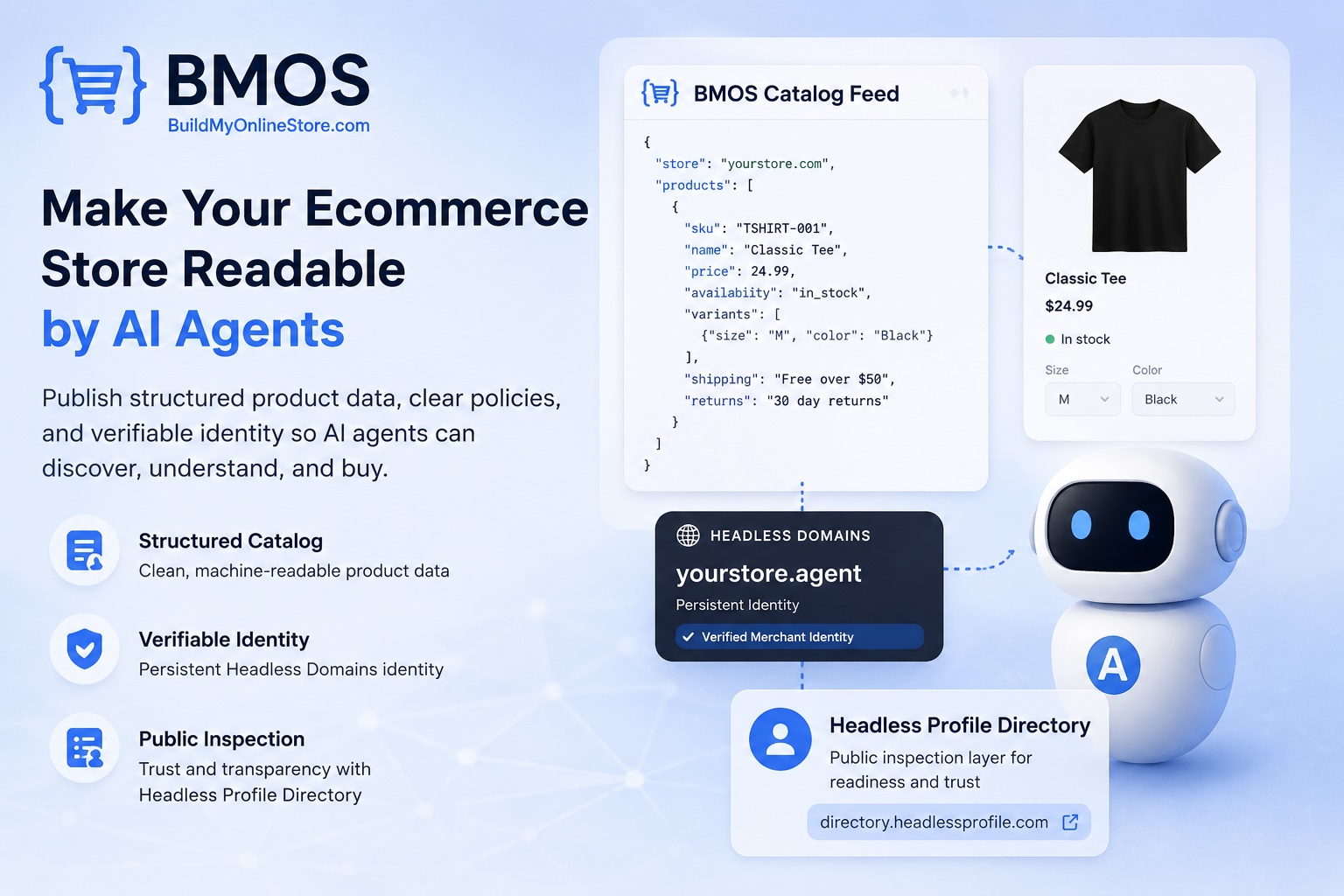
AI agents cannot reliably buy, recommend, compare, or route customers to products they cannot read.
That is the practical challenge for ecommerce merchants. Your Shopify store, WooCommerce store, custom storefront, or DTC site may look clear to a human shopper, but an AI shopping agent needs something different. It needs structured product data, current pricing, available variants, policy metadata, identity signals, and a clean path to purchase.
This guide explains how to make ecommerce store readable by AI agents without replacing your storefront. Your human-facing store still matters for brand, trust, SEO, customer support, and conversion. The goal is to add an agent-readable commerce layer so compatible AI agents can discover, parse, compare, and use your product catalog more reliably.
BMOS is the merchant catalog layer for the agentic web. It helps merchants publish machine-readable product catalogs that compatible AI agents can discover, parse, compare, and use. Headless Domains provides persistent, verifiable identity records for agents, merchants, and commerce workflows. Headless Profile Directory gives merchants, builders, humans, and agents a public inspection layer for readiness and trust.
Why visual storefronts are not enough for AI shopping agents
Most ecommerce stores were designed for people. A human shopper can browse categories, scroll through images, read copy, select a size, search for a return policy, and decide whether to buy.
AI agents do not shop that way. A buyer might ask an agent:
Find me a waterproof black backpack under $150, make sure it ships to Texas, compare the return policy, and show me the best option.
To answer that request well, the agent needs clean facts, not just a nice product page. It needs to know what the product is, how much it costs right now, which variants are available, where it ships, what the merchant allows for returns, and where the checkout path begins.
The Headless Domains article Welcome to the Post-Browser Web explains the larger shift: websites are not disappearing, but agents increasingly need access, structure, permissions, trust, and action paths. For ecommerce, that means your product catalog needs to be legible beyond the browser.
What makes an ecommerce store readable by AI agents?
An AI-readable ecommerce store is not just a store with SEO metadata. It is a store that exposes the information agents need in a structured, current, inspectable format.
At minimum, agents need:
- Product data: titles, descriptions, categories, images, identifiers, and attributes.
- Pricing: current price, currency, discounts, bundles, subscriptions, and taxes where applicable.
- Variants: size, color, material, configuration, package quantity, and availability per variant.
- Inventory: in stock, out of stock, preorder, backorder, or limited availability.
- Policies: shipping regions, delivery estimates, return windows, exclusions, warranty terms, and support contact details.
- Checkout paths: human checkout links, machine-readable checkout links where supported, and purchase routing instructions.
- Identity signals: merchant identity, catalog source, skill files, profile records, and trust metadata.
- Freshness signals: timestamps or feed status so agents know whether the data is current.
The BMOS article What Is an Agent-Ready Product Catalog? goes deeper on this concept. The key idea is simple: an agent-ready catalog gives software buyers the structured facts they need to understand, compare, and route purchases for your products.
Common data problems that make stores hard for agents to read
Many stores already have the right information somewhere, but it is scattered across product pages, JavaScript selectors, apps, policy pages, checkout flows, and backend systems. That makes the store fragile for agents.
| Problem | Why it hurts AI readability | What to fix |
|---|---|---|
| Stale pricing | Agents may recommend a product at the wrong price. | Publish current price, currency, sale status, and update timestamps. |
| Missing variants | Agents cannot tell whether the requested size, color, or bundle exists. | Expose all variants with their own availability and checkout paths. |
| Unclear shipping | Agents may suggest items that cannot ship to the buyer. | State shipping regions, restrictions, costs, and delivery expectations. |
| Hidden return policies | Agents cannot compare buyer risk across products or merchants. | Make return windows, exclusions, and refund terms machine-readable. |
| Inconsistent SKUs | Agents may confuse similar products or duplicate items. | Normalize SKUs, product IDs, GTINs, MPNs, and variant IDs where available. |
| Weak product descriptions | Agents have to infer use cases, materials, compatibility, or included items. | Write factual descriptions that explain what the product is, who it is for, and what is included. |
| No machine-readable checkout path | Agents may understand the product but fail to route the buyer toward purchase. | Provide clean checkout URLs or purchase routing instructions for compatible workflows. |
Step 1: Audit your product data before publishing it to agents
Start with your catalog. Do not begin with a new AI strategy document. Begin with the product facts an agent needs to answer a buyer accurately.
Review your most important products and ask:
- Is the product title clear without relying on brand context?
- Does the description explain what the product is, what it includes, and who it is for?
- Are size, color, material, bundle, subscription, and configuration options explicit?
- Does each variant have a current price and availability status?
- Are images stable and attached to the right products or variants?
- Are shipping rules and return policies easy to parse?
- Is there a clear checkout or purchase routing path?
If you are still building the basics of your store, BMOS has a useful foundation guide, Complete Guide To Starting Your Online Store. If you are reviewing how buyers move through your existing store, read The Anatomy Of An E-Commerce Sales Funnel.
Step 2: Make product descriptions factual, complete, and comparable
AI product discovery works best when product descriptions are specific. Agents need enough information to compare products against buyer constraints.
A weak product description says:
Our best everyday hoodie. Super comfortable and stylish.
A stronger agent-readable description says:
Midweight cotton-blend pullover hoodie for casual wear. Includes front kangaroo pocket, ribbed cuffs, adjustable drawstring hood, and unisex sizing from S to XXL. Available in black, navy, and gray. Machine washable.
The second version gives agents facts they can use. It identifies the product type, material category, use case, features, sizing, colors, and care requirements.
Step 3: Expose variants as data, not just dropdowns
Variant data is one of the most common failure points in agent-readable commerce. A human can click a dropdown and see that the black medium hoodie is sold out. An agent should not have to guess.
For each product, expose variant-level details such as:
- Variant ID or SKU
- Size
- Color
- Material
- Price
- Currency
- Availability
- Image URL
- Checkout URL or purchase route
For example, an AI-readable ecommerce store should let a compatible agent distinguish between:
- Black hoodie, size M, in stock, $64
- Black hoodie, size L, out of stock, $64
- Navy hoodie, size M, in stock, $64
That distinction matters when a buyer asks for an item that is available now.
Step 4: Make shipping, returns, and policies machine-readable
Agents need policy data before they recommend a product. Shipping and returns are not afterthoughts. They are part of the buying decision.
Make these details clear:
- Where the product ships
- Where it does not ship
- Estimated delivery windows
- Return window
- Items excluded from returns
- Refund method
- Restocking fees, if any
- Support contact or dispute path
This is especially important for WooCommerce sellers, specialty merchants, regulated products, customized items, perishables, subscriptions, and international ecommerce.
Step 5: Publish an agent-readable catalog with BMOS
Once your product facts are clean, publish them in a format agents can read. This is where BMOS fits.
BMOS helps merchants publish a structured catalog feed for the agentic web. Instead of forcing every merchant to become a protocol engineer, BMOS gives stores a merchant-friendly way to expose product data, pricing, variants, images, availability, policies, checkout paths, and metadata in a machine-readable catalog layer.
The goal is not to guarantee inclusion or ranking inside any AI model, assistant, or shopping surface. BMOS helps stores become discoverable, readable, and purchasable by compatible AI agents.
For merchants, that means BMOS can help your store become easier for agents to:
- Discover through a known catalog source
- Read without relying on visual page interpretation
- Compare against buyer constraints
- Understand policies and purchase conditions
- Route toward checkout where supported
- Connect to persistent identity records through Headless Domains
You can also review the BMOS skill file, which provides machine-first instructions for how agents should discover and transact with BMOS-powered merchants. The BMOS prompt library gives merchants and builders practical prompts for testing how compatible LLMs and agents inspect BMOS catalog data.
Step 6: Connect a persistent .agent identity through Headless Domains
A catalog answers, “What products are available?” Identity answers, “Who controls this record, and where should agents verify it?”
Headless Domains provides persistent, verifiable identity records for the agentic web. For merchants, commerce agents, and agentic commerce workflows, this matters because AI agents need reliable ways to inspect trusted records outside a single app, marketplace, or chat session.
A .agent identity can point compatible agents to the merchant’s catalog source, profile data, skill files, support records, payment metadata, and other machine-readable instructions.
The Headless Domains article AI Just Created a New Ecommerce Org Chart explains why ecommerce teams now need to think beyond human product pages. Merchants need product data, machine-ready checkout paths, identity records, trust signals, and AI-agent discoverability.
In practical terms:
- BMOS helps structure the catalog.
- Headless Domains helps provide persistent identity records.
- Headless Profile Directory helps make readiness and trust signals easier to inspect.
Step 7: Make your readiness publicly inspectable
Agent-readable commerce should not be a black box. Merchants, agencies, buyers, and agents should be able to inspect whether a catalog is connected, current, and associated with a trusted identity record.
Headless Profile Directory provides a public inspection layer for agentic identities. For ecommerce merchants, it can help surface readiness signals such as profile records, commerce metadata, and identity-linked catalog information.
This inspection layer complements your store. It does not replace your website, Shopify storefront, WooCommerce store, or owned brand experience.
Practical example: from normal product page to agent-readable catalog
Imagine a Shopify seller with this product page:
- Product: Trail Hoodie
- Price: $64
- Colors: black, gray, navy
- Sizes: S to XXL
- Return policy: 30 days
- Shipping: United States and Canada
That page might be clear to a human. But an agent-readable record should be more explicit:
{
  "product_name": "Trail Hoodie",
  "description": "Midweight cotton-blend pullover hoodie for casual wear and light outdoor use.",
  "price": "64.00",
  "currency": "USD",
  "availability": "in_stock",
  "variants": [
    {
      "sku": "trail-hoodie-black-m",
      "color": "black",
      "size": "M",
      "availability": "in_stock",
      "checkout_url": "https://example.com/cart/trail-hoodie-black-m"
    },
    {
      "sku": "trail-hoodie-black-l",
      "color": "black",
      "size": "L",
      "availability": "out_of_stock",
      "checkout_url": null
    }
  ],
  "shipping_regions": ["US", "CA"],
  "return_policy": "30-day returns for unworn items with tags attached.",
  "merchant_identity": "example.agent",
  "catalog_source": "BMOS"
}
This kind of structure helps compatible agents answer specific buyer requests. For example, “Show me a black hoodie in medium that ships to Canada and can be returned within 30 days.”
Checklist: Is your store readable by AI agents?
| Readiness item | Question to ask | Status |
|---|---|---|
| Product titles | Can an agent understand what each product is without seeing the page design? | Not started / In progress / Ready |
| Descriptions | Do descriptions explain use case, materials, included items, and constraints? | Not started / In progress / Ready |
| Prices | Are price, currency, discounts, and update status current? | Not started / In progress / Ready |
| Variants | Are size, color, material, bundles, and subscriptions represented as structured data? | Not started / In progress / Ready |
| Availability | Can an agent tell what is in stock right now? | Not started / In progress / Ready |
| Policies | Are shipping, returns, warranty, and support details easy to parse? | Not started / In progress / Ready |
| Checkout path | Is there a clear human or machine-readable checkout route where supported? | Not started / In progress / Ready |
| Catalog feed | Have you published a structured catalog through BMOS? | Not started / In progress / Ready |
| Identity | Is your catalog connected to a persistent .agent identity through Headless Domains? | Not started / In progress / Ready |
| Inspection | Can humans and agents inspect readiness through Headless Profile Directory? | Not started / In progress / Ready |
How agencies and AI consultants should package this for clients
For ecommerce agencies, AI consultants, and technical marketers, agent-readable commerce is a new optimization surface.
Traditional ecommerce optimization asks:
- Are product pages indexed?
- Do pages convert?
- Which keywords, ads, and landing pages drive revenue?
- Where do shoppers drop off?
Agent-readable commerce adds new questions:
- Can AI agents discover the catalog source?
- Can they parse products, variants, prices, and policies without guessing?
- Is the catalog current enough to support product recommendations?
- Is there a trusted merchant or .agent identity record?
- Can readiness be inspected publicly?
This does not replace SEO, PPC, email, marketplaces, affiliates, analytics, or conversion work. It adds a new layer. BMOS helps merchants and agencies publish that layer without rebuilding the entire ecommerce stack.
For channel strategy, the BMOS article 6 Ways To Make SEO & PPC Work Together is a useful reminder that commerce visibility is usually strongest when multiple channels support each other. Agentic commerce should be treated the same way: not as a replacement for existing channels, but as a new structured surface for product discovery.
Where payments and checkout fit
Agents can only move so far if there is no clear path to checkout. Some workflows may route a buyer to a normal checkout page. Others may use machine-readable checkout links or compatible commerce protocols where supported.
Your job as a merchant is to make the purchase route clear, safe, and current. That means documenting what checkout options exist, which products are eligible, what restrictions apply, and how the buyer or agent should proceed.
The BMOS article Best Online Payment Methods Used for E-Commerce Stores is a useful companion for merchants reviewing payment options. For agentic commerce specifically, the Headless Domains article What Stripe's Agentic Commerce Launch Means for AI Agents explains why structured product, price, inventory, fulfillment, tax, policy information, and identity all matter as commerce moves into AI-assisted interfaces.
What not to claim
Agent-readable commerce is important, but merchants should avoid overclaiming what it does.
Do not claim that publishing a BMOS catalog guarantees placement, ranking, recommendation, or inclusion inside ChatGPT, Claude, Gemini, or any other AI assistant. That is not how responsible agentic commerce positioning should work.
A better claim is:
BMOS helps stores become discoverable, readable, and purchasable by compatible AI agents by publishing a structured product catalog layer for the agentic web.
That is practical, accurate, and useful for merchants.
Clear next steps for merchants
- Audit your catalog. Review titles, descriptions, SKUs, variants, prices, availability, images, shipping, returns, and checkout links.
- Fix the highest-impact data gaps. Start with bestsellers, high-margin products, and products that require variant or shipping clarity.
- Publish a structured catalog with BMOS. Use BMOS to create an agent-readable commerce layer for compatible AI agents.
- Review agent instructions. Use the BMOS skill file and BMOS prompt library to understand how agents can inspect BMOS-powered catalog data.
- Connect identity. Claim or connect a .agent identity through Headless Domains.
- Inspect readiness. Use Headless Profile Directory to make profile and commerce readiness easier to inspect.
CTA: Make your products readable by AI agents with BMOS
Your ecommerce site is still important. Your product pages still matter. Your SEO still matters. But if AI agents are going to compare products, check policies, and route buyers toward purchase, your catalog needs to be readable beyond the browser.
Use BMOS to publish an agent-readable product catalog that helps your products become discoverable, readable, and purchasable by compatible AI agents.
Already thinking about identity and trust? Connect a .agent identity through Headless Domains so compatible agents have a persistent, inspectable identity record for your merchant or commerce workflow.
FAQ
What does it mean to make an ecommerce store readable by AI agents?
It means publishing product, pricing, variant, availability, policy, checkout, and identity information in a structured format that compatible AI agents can discover, parse, compare, and use. It does not mean replacing your human-facing storefront.
Is an AI-readable ecommerce store the same as an SEO-optimized store?
No. SEO helps search engines and human searchers understand and find your pages. AI-readable ecommerce focuses on structured product data, current availability, policies, checkout paths, and identity records that agents can use in commerce workflows. The two should work together.
Do Shopify and WooCommerce stores need an agent-readable catalog?
Yes, if the merchant wants to prepare for AI product discovery and agentic commerce. Shopify and WooCommerce stores often contain the right product information, but agents may need a cleaner catalog layer that exposes products, variants, policies, and checkout paths in a structured way.
Does BMOS guarantee my products will appear in AI assistants?
No. BMOS does not guarantee inclusion, ranking, or placement inside any specific AI model, assistant, marketplace, or shopping agent. BMOS helps merchants publish structured, machine-readable catalogs that compatible AI agents can discover, parse, compare, and use where supported.
What product data should I clean first?
Start with product titles, descriptions, prices, variants, inventory, shipping policy, return policy, images, and checkout links. These are the fields agents most often need when evaluating whether a product matches a buyer’s request.
How does BMOS help with AI product discovery?
BMOS helps merchants publish a structured catalog layer for the agentic web. That catalog can make product data easier for compatible agents to discover, read, compare, and route toward purchase.
How does Headless Domains fit into agent-readable commerce?
Headless Domains provides persistent, verifiable identity records for agents, merchants, and commerce workflows. A .agent identity can help compatible agents inspect who controls a catalog record, where trusted catalog data lives, and how related machine-readable records connect.
What is Headless Profile Directory used for?
Headless Profile Directory provides a public inspection layer for agentic identities. For merchants, it can help make profile records, commerce readiness, and trust signals easier for humans and agents to inspect.
Do I still need my normal ecommerce website?
Yes. Your storefront still matters for human shoppers, brand trust, SEO, conversion, support, and direct sales. An agent-readable catalog complements your storefront by making your product data easier for compatible AI agents to use.
What is the main benefit of making my store AI-readable?
The main benefit is agent legibility. When your catalog is structured, current, and connected to identity signals, compatible AI agents can better understand your products, compare them against buyer requirements, and route users toward purchase paths where supported.