
ACP vs UCP for Ecommerce Merchants: What Store Owners Need to Know
May 9, 2026
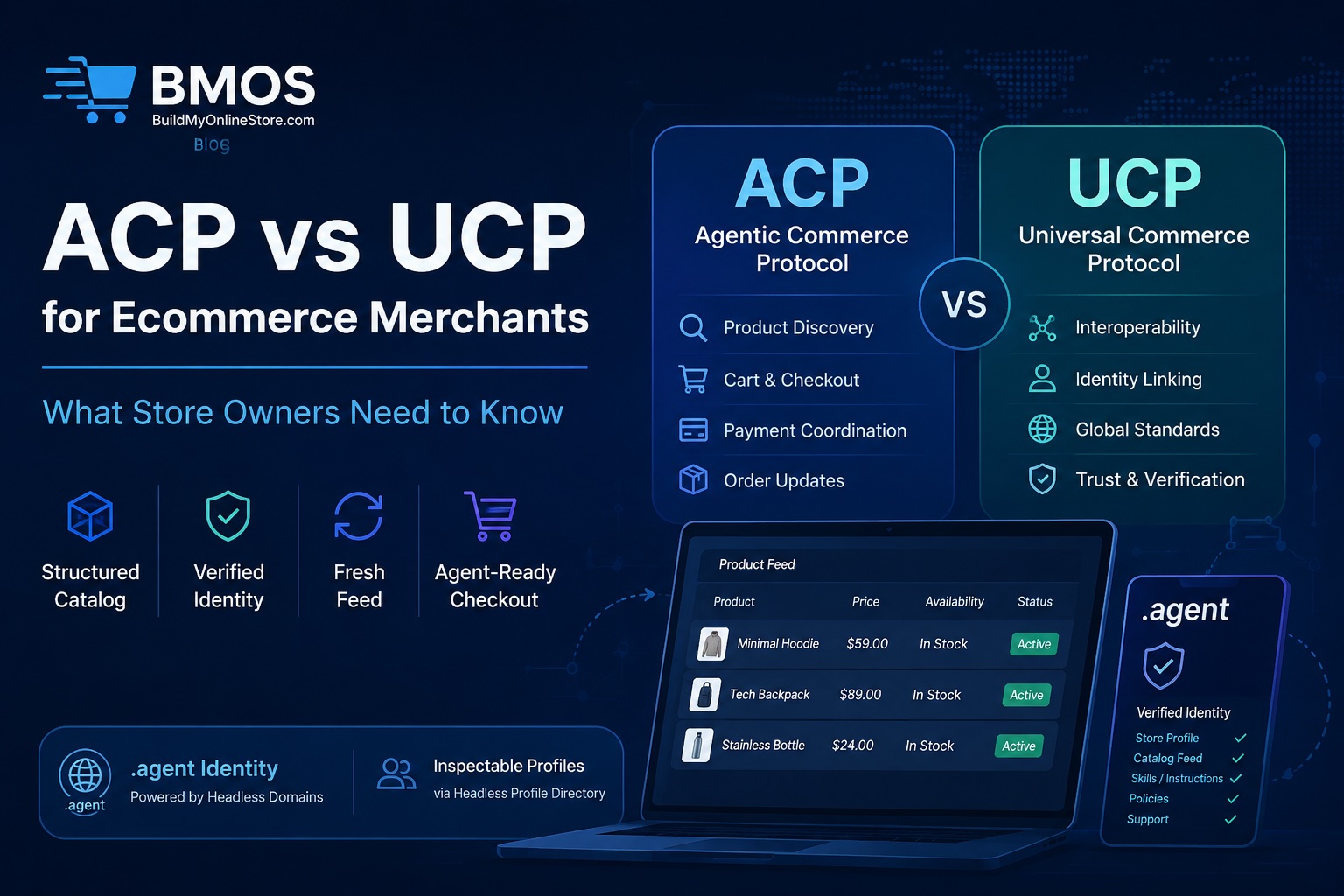
ACP vs UCP ecommerce is becoming a practical question for merchants, not just a technical debate for developers. As AI agents begin helping shoppers discover products, compare options, build carts, and complete checkout, store owners need to understand what these standards mean at a business level.
The good news: you do not need to memorize every protocol detail to get ready. Most merchants need the same foundation no matter which standard gains adoption in a given channel: structured product data, accurate availability, clear checkout paths, published policies, and a verifiable commerce identity.
BMOS helps merchants prepare that foundation in plain English. Instead of asking Shopify sellers, WooCommerce sellers, agencies, and catalog managers to implement every agentic commerce protocol by hand, BMOS focuses on making the catalog, feed, checkout, and identity layer easier to publish, inspect, and keep current.
What are ACP and UCP?
ACP usually refers to the Agentic Commerce Protocol. At a high level, ACP is designed to help AI agents and businesses coordinate commerce flows such as product discovery, cart creation, checkout, payment credential handling, and order updates.
UCP usually refers to the Universal Commerce Protocol. At a high level, UCP is designed to standardize commerce interactions across AI surfaces, merchants, payment providers, credential providers, and related ecosystem participants.
For a merchant, the difference is less about choosing a side and more about preparing your store so it can be understood by compatible AI shopping systems. ACP and UCP are both part of the broader shift toward agentic commerce, where AI agents can help customers shop through conversation, search, apps, and other agentic web interfaces.
The simple merchant version
Think of ACP and UCP as different ways for AI commerce systems to ask and answer questions like:
- What products does this merchant sell?
- What variants, prices, images, and availability are current?
- Can this item be purchased through an agent-ready checkout?
- What shipping, return, refund, tax, and support policies apply?
- Who controls this catalog and where can the official record be verified?
- How should the buyer, agent, merchant, and payment provider coordinate safely?
That is why merchant readiness starts with the data layer. If your catalog is messy, outdated, incomplete, or locked inside a storefront theme that only humans can browse, agents have a harder time understanding what you sell.
ACP vs UCP for ecommerce merchants
| Standard | What it helps with | What merchants must prepare | How BMOS helps |
|---|---|---|---|
| ACP Agentic Commerce Protocol |
Agent-ready product discovery, cart, checkout, payment coordination, and order updates. | Structured product feed, current price and inventory, clear variants, checkout routes, fulfillment data, return policy, support information. | BMOS publishes an agent-readable commerce catalog so merchants can prepare for ACP-style flows without building the feed layer from scratch. |
| UCP Universal Commerce Protocol |
Interoperability across commerce surfaces, agents, payment providers, identity linking, checkout, order status, and post-purchase workflows. | Clean catalog records, product URLs, policies, checkout configuration, account or identity linking where needed, order status paths, fresh feed updates. | BMOS helps merchants keep product data and checkout metadata structured for UCP-style agentic commerce use cases. |
| Identity layer .agent through Headless Domains |
A persistent, machine-readable place to verify commerce records, catalog pointers, skills, and public agent identity data. | A trusted identity record, catalog feed pointer, machine-readable instructions, and inspectable public profile. | BMOS can connect commerce readiness to a .agent identity through Headless Domains and make readiness easier to inspect through Headless Profile Directory. |
Do merchants need to pick ACP or UCP?
Not yet. Most merchants should avoid turning this into a protocol ideology piece. ACP, UCP, and related AI commerce standards are still developing. Different AI platforms, payment providers, marketplaces, and commerce systems may support different paths.
The practical move is to prepare your store so it can support multiple standards. That means keeping your product data portable, your checkout routes clear, your policies machine-readable, and your identity layer inspectable.
This is also why no lock-in matters. A merchant should not have to rebuild their catalog every time a new AI shopping surface, agent marketplace, checkout provider, or protocol gains traction. Your store data should be reusable across the agentic web.
What merchants actually need to prepare
Whether your store is on Shopify, WooCommerce, a custom backend, or a catalog management system, agent-ready ecommerce depends on a few core assets.
1. A structured product catalog
AI agents need more than a product page. They need clean product records with titles, descriptions, images, variants, prices, availability, categories, attributes, and product identifiers.
For example, a human can understand a product page that says “Large black tee, ships tomorrow.” An agent needs that same information in structured form:
- Product name: Heavyweight Cotton T-Shirt
- Variant: Black, Large
- Price: 26.00 USD
- Availability: In stock
- Fulfillment: Ships in 1 business day
- Return policy: 30-day returns, unworn items only
- Checkout URL: Human checkout and agent-ready checkout route
2. Fresh price and inventory data
Agentic commerce breaks down quickly if an AI assistant recommends products that are out of stock or priced incorrectly. Freshness matters. Merchants should prepare for feeds that can be refreshed on a regular cadence and updated when inventory, pricing, promotions, or variants change.
The BMOS skill file is designed to help AI agents locate the current BMOS catalog feed and use fresh data instead of relying on stale model memory.
3. Checkout routes for humans and agents
A normal ecommerce checkout is built for a person using a browser. An agent-ready checkout must also be understandable to software acting on behalf of a buyer.
That does not mean removing human review. In many cases, the best experience is:
- The customer asks an AI agent for a recommendation.
- The agent reads the merchant’s structured catalog.
- The agent presents matching products with current pricing.
- The customer approves the item, shipping option, and payment step.
- The transaction routes through the merchant’s supported checkout flow.
- The merchant remains responsible for fulfillment, support, and policies.
BMOS supports this by helping merchants publish commerce records that include product data and checkout metadata in a way agents can inspect.
4. Clear merchant policies
Agents need to answer customer questions before purchase. Your policies should be easy to find, current, and consistent across your site and feed.
Prepare structured answers for:
- Shipping regions and delivery estimates
- Return window and return conditions
- Refund process
- Exchange policy
- Warranty or guarantee terms
- Customer support contact
- Restricted products or eligibility rules
For example, a WooCommerce seller with made-to-order products should make production time explicit. A Shopify seller with final-sale clearance products should make that policy clear before an agent recommends the item.
5. A persistent identity record
Commerce protocols help with transactions, but merchants and agents also need verification. If a catalog feed says it belongs to your store, where can another agent verify that claim?
This is where Headless Domains fits into the stack. A .agent identity can provide a persistent, machine-readable place to publish commerce pointers, agent instructions, and verification records. Headless Profile Directory then helps make those records easier to inspect.
For deeper context on why agentic commerce needs both transaction standards and persistent identity, read What Stripe's Agentic Commerce Launch Means for AI Agents from Headless Domains.
Where BMOS fits
BMOS is built for merchants who want to prepare for agentic commerce standards without becoming protocol engineers.
Instead of starting with a technical spec, BMOS starts with the merchant workflow:
- Connect or build a catalog.
- Make product data cleaner and easier for agents to read.
- Publish an agent-readable commerce feed.
- Include checkout and policy metadata.
- Support ACP and UCP readiness in one merchant-friendly layer.
- Connect the feed to a .agent identity when the merchant wants a persistent verification surface.
The result is a more practical path to agent-ready ecommerce. A merchant can focus on product accuracy, customer experience, fulfillment, and brand trust while BMOS handles much of the catalog readiness work.
For agent testing and prompt examples, BMOS also publishes a Prompt Library that shows how humans and AI systems can ask an LLM to resolve a .agent identity, inspect catalog records, and list products with current buying options.
Practical examples
Example 1: Shopify apparel store
A Shopify seller has 300 SKUs across shirts, hats, and accessories. The storefront looks good to humans, but product variants are inconsistent. Some colors are written as “navy,” “blue navy,” and “dark blue.” Some size charts are in images only.
Before worrying about ACP vs UCP, the merchant should clean the catalog. BMOS can help structure titles, variants, pricing, images, product URLs, and checkout metadata so agents can recommend the right size and color with fewer mistakes.
Example 2: WooCommerce specialty food store
A WooCommerce merchant sells regional food products with shipping restrictions. Some items cannot ship to certain states or countries. Some products require cold shipping.
For agentic commerce, the critical issue is not only the protocol. The critical issue is whether the agent can understand availability, shipping limits, delivery timing, and refund policy before recommending the product. BMOS readiness work should include structured shipping rules and policy data.
Example 3: Agency managing multiple stores
An ecommerce agency manages 25 client catalogs. Each client uses a different theme, checkout app, and product naming convention.
Instead of custom-building every agentic commerce integration from zero, the agency can use BMOS as a readiness layer. The agency can standardize product feeds, policy fields, checkout metadata, and .agent identity connections across clients.
Why no lock-in matters
Agentic commerce is early. Merchants should be careful about any solution that only prepares them for one AI surface, one payment provider, one marketplace, or one checkout path.
A practical agent-ready strategy should be:
- Portable: Your catalog should be reusable across AI commerce standards.
- Inspectable: Agents should be able to verify where the feed comes from.
- Fresh: Pricing, inventory, and policies should not depend on stale pages.
- Merchant-controlled: The merchant should keep control of fulfillment, customer relationships, and store operations.
- Protocol-aware, not protocol-trapped: The merchant should be ready for ACP, UCP, and future AI commerce standards without rebuilding everything each time.
How .agent identity supports ACP and UCP readiness
A .agent identity is not a replacement for ACP or UCP. It is a complementary identity layer.
Commerce standards can define how transactions happen. A .agent identity can help define where trusted machine-readable records live. For merchants, that can include catalog feed pointers, skill files, checkout metadata, support links, policy records, and verification data.
Headless Domains provides the persistent identity layer for the agentic web. BMOS can feed commerce readiness into that identity layer, and Headless Profile Directory can make the readiness inspectable to humans, agents, builders, and directories.
For a technical overview of API and agent readiness, see How to Make Your API Agent-Ready.
Merchant readiness checklist
Use this checklist before asking which protocol your store should support first:
- Product titles are clear and descriptive.
- Descriptions explain features, materials, dimensions, compatibility, and use cases.
- Every variant has a clean SKU, price, image where needed, and availability status.
- Product categories and attributes are consistent.
- Inventory and price data can be refreshed.
- Checkout URLs are stable and trackable.
- Return, refund, shipping, warranty, and support policies are published.
- Restricted products and eligibility rules are documented.
- The catalog can be exported or published as a structured feed.
- The merchant has a persistent identity or verification surface, such as a .agent record.
What to do next
If you are a merchant, the best next step is not to wait for one standard to “win.” The best next step is to make your store legible to agents.
Start by using BMOS to prepare your catalog for agentic commerce readiness. BMOS gives merchants a practical way to publish cleaner product data, agent-readable commerce feeds, checkout metadata, and AI shopping instructions without forcing your team to become ACP or UCP specialists.
Then connect your commerce records to a persistent .agent identity through Headless Domains so agents, directories, and tools have a verifiable place to inspect your readiness.
Primary CTA: Use BMOS to prepare your store for ACP, UCP, and agent-ready ecommerce.
Secondary CTA: Connect a .agent identity through Headless Domains and make your commerce records easier to verify across the agentic web.
FAQ
What is ACP in ecommerce?
ACP stands for Agentic Commerce Protocol. It is an open standard designed to help AI agents and businesses coordinate commerce flows such as catalog discovery, checkout, payment credential handling, and order updates.
What is UCP in ecommerce?
UCP stands for Universal Commerce Protocol. It is an open commerce standard designed to support interoperability across AI surfaces, merchants, payment providers, credential providers, checkout, identity linking, order tracking, and related commerce workflows.
Is ACP better than UCP?
For most merchants, that is the wrong starting question. ACP and UCP may serve different ecosystems and integration paths. Merchants should focus first on structured catalog data, fresh feeds, checkout readiness, clear policies, and verifiable identity.
Do I need ACP or UCP if I already have Shopify?
Your Shopify store is still important, but AI agents need structured data and checkout metadata they can understand programmatically. BMOS helps bridge the gap between a human-facing storefront and an agent-readable commerce catalog.
Do I need ACP or UCP if I use WooCommerce?
WooCommerce merchants can also prepare for agentic commerce by cleaning product data, publishing structured feeds, documenting policies, and making checkout routes easier for agents to understand. BMOS can help make that readiness more standardized.
Does BMOS replace my ecommerce platform?
BMOS is designed as a merchant-friendly product catalog and agentic commerce readiness layer. It does not require merchants to treat one storefront, protocol, or payment path as the only future.
Why does .agent identity matter for ecommerce?
A .agent identity gives merchants and agents a persistent, machine-readable place to publish and verify commerce records. That can make catalog feeds, checkout metadata, skill files, and policy pointers easier to inspect across tools and directories.
What is Headless Profile Directory?
Headless Profile Directory is an inspection surface for agentic identities. For commerce, it helps make readiness signals easier for humans, agents, and builders to review.
What is the fastest way to get ready?
Clean your catalog first. Then publish an agent-readable feed through BMOS, review the BMOS skill file, test discovery prompts in the BMOS Prompt Library, and connect a .agent identity through Headless Domains.