
Product Feed Optimization for AI Agents
May 11, 2026
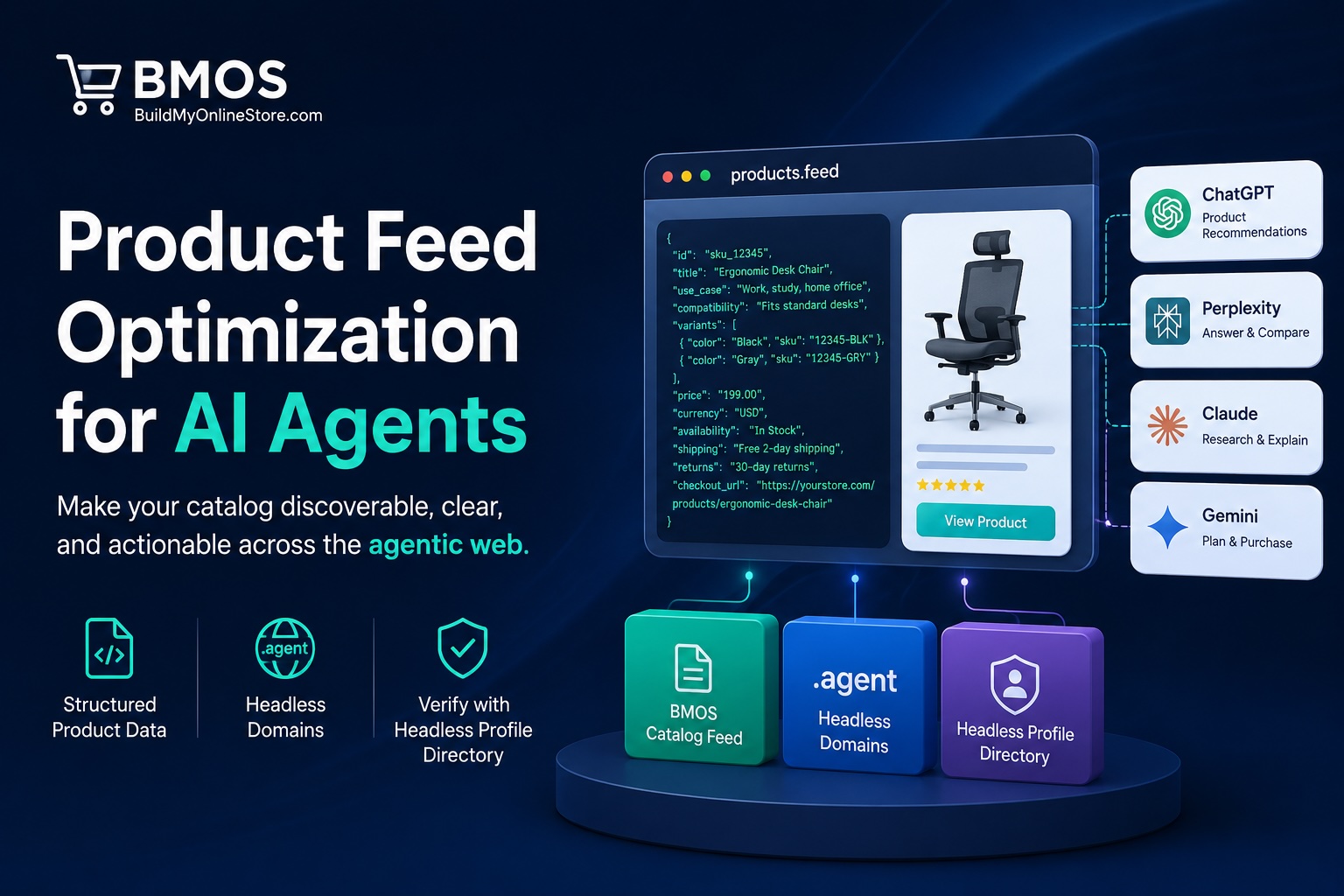
Product feed optimization for AI agents means structuring catalog data so software buyers can discover products, compare options, explain tradeoffs, check policies, and route purchases with fewer guesses. Traditional feed work still supports ad platforms, marketplaces, search engines, and paid shopping teams. The AI commerce layer adds fields and context agents need: use case, compatibility, variants, constraints, inventory, shipping, returns, and checkout links.
BMOS helps merchants publish a cleaner AI product feed and BMOS catalog feed built for agent-readable feed workflows across the agentic web. The responsible promise stays narrow: structured, current, inspectable commerce data can help compatible agents parse a catalog, understand buyer constraints, and prepare the next action with clearer source data. No feed, schema, directory, or identity layer can guarantee AI rankings, recommendations, traffic, or sales.
Why product feed optimization has a new layer
For years, ecommerce product data optimization focused on channel fit. Google Shopping, Meta, marketplaces, affiliate systems, comparison engines, and retail media networks each needed clean titles, categories, prices, images, identifiers, and availability. Better feed hygiene could improve eligibility, diagnostics, ad relevance, catalog matching, and shopping campaign control.
AI agents introduce a different reader. A buyer agent may receive a request such as “find a waterproof hiking backpack under $150, confirm it ships to Bangkok, explain the return window, and prepare a checkout route.” The agent needs more than a keyword-rich title. It needs enough structured product and policy context to compare, explain, recommend when supported by its own system rules, and prepare a purchase path.
Ambiguity creates friction. Missing variant availability, vague compatibility language, hidden shipping restrictions, unclear return rules, stale inventory, or broken checkout URLs can cause an agent to skip a product, give a weak answer, or send a buyer to an unsuitable page.
Traditional feed optimization vs AI agent feed optimization
| Area | Traditional product feed optimization | AI agent feed optimization |
|---|---|---|
| Primary reader | Ad platforms, marketplaces, search engines, retail media systems, and channel crawlers. | AI shopping agents, buyer agents, catalog inspectors, commerce agents, and technical review tools. |
| Main goal | Improve product eligibility, matching, ad relevance, channel diagnostics, and campaign performance. | Help compatible agents read, compare, explain, verify, and route products with fewer assumptions. |
| Core fields | Title, description, category, price, currency, image, brand, GTIN, MPN, SKU, condition, and availability. | All traditional fields plus use case, compatibility, variant-level constraints, policy summaries, support route, source record, and checkout metadata. |
| Policy data | Often handled through landing pages, account settings, or marketplace policy settings. | Shipping regions, delivery expectations, return windows, exclusions, warranty terms, and support contact should be readable from the commerce layer. |
| Identity | Usually tied to domain reputation, merchant account, marketplace account, or ad account verification. | A persistent .agent identity can point agents to the trusted source-of-truth feed, skill file, profile record, and approved endpoints. |
| Failure mode | Disapproved products, poor matching, low quality score, weak click-through, or channel diagnostics. | Skipped products, unclear recommendations, incorrect explanations, weak trust signals, or broken purchase routing. |
What agents need from an AI product feed
An AI product feed should treat each catalog item as a decision record. Product pages can persuade humans, while an agent-readable feed should answer operational questions without forcing the agent to infer from design, images, scripts, dropdowns, or scattered policy pages.
Use case and buyer fit
Describe the product in factual language. Include who it suits, what use case it serves, what it includes, and where it should avoid use. A camping stove, skincare product, SaaS plan, or replacement part needs context that helps an agent match the product to a request.
Compatibility and constraints
Agents need compatibility data before recommending accessories, replacement parts, electronics, software, apparel sizes, or regulated categories. Include model numbers, platform support, dimensions, material details, region limits, age restrictions where applicable, warranty exclusions, and safe-use notes.
Variants and inventory
Variant-level data should expose SKU or variant ID, color, size, material, bundle, subscription status, price, currency, availability, image URL, and checkout route. A single parent product with hidden variant details leaves an agent guessing.
Policies and checkout links
Agents need policy clarity to compare offers. Provide shipping regions, delivery estimates, return windows, refund method, final-sale exclusions, support contact, and human checkout links. When machine checkout paths exist, label eligibility, approval rules, and fallback behavior clearly.
Where BMOS fits
BMOS provides a merchant-friendly catalog layer for agentic commerce. Merchants can use BuildMyOnlineStore.com to publish structured product data, prices, variants, images, policy metadata, and checkout paths in a form compatible agents can inspect. The BMOS skill file gives agents instructions for resolving a merchant identity, locating catalog records, fetching the feed, and following commerce workflow guidance. The BMOS prompt library gives merchants and builders test prompts for checking agent discovery flows.
For related BMOS reading, start with How to Make Your Ecommerce Store Readable by AI Agents, which explains the product, pricing, variant, policy, checkout, identity, and freshness fields agents need. Pair it with What Is an Agent-Ready Product Catalog?, which frames the agent-ready catalog as a structured, current commerce feed for discovery, comparison, and purchase routing.
Where Headless Domains fits
Product feed optimization covers the catalog. Identity covers source trust. Headless Domains gives merchants, commerce agents, and agentic workflows a persistent identity record for the agentic web. A .agent identity can point compatible agents to a trusted BMOS feed, agent.json, SKILL.md, support links, policy links, checkout metadata, and public profile records.
The Headless Domains article Why Your Store Needs a .agent Identity for Ecommerce Before AI Agents Can Trust It explains why catalog data and merchant identity should work together. Headless Profile Directory adds an inspection layer so teams, buyers, builders, and compatible agents can review readiness signals linked to the identity record.
A practical optimization checklist
- Clean core product facts. Normalize titles, descriptions, categories, identifiers, images, price, currency, and availability.
- Audit variants. Confirm each buyable option has its own SKU or variant ID, attributes, price, stock status, image, and checkout link.
- Write for comparison. Add use case, materials, dimensions, included items, compatibility, exclusions, and care or setup details.
- Expose policies. Make shipping, returns, warranty, support, refund method, and restrictions readable from the commerce layer.
- Publish an agent-readable feed. Use BMOS to create a consistent AI shopping feed that compatible agents can inspect.
- Connect identity. Use Headless Domains to point a .agent record toward the trusted feed, skill file, and profile record.
- Inspect the setup. Review Headless Profile Directory for public readiness signals, then test with prompts from the BMOS prompt library.
Before and after: bad product data vs agent-ready product data
| Feed field | Bad product data | Agent-ready product data |
|---|---|---|
| Title | Best hoodie | Midweight cotton-blend pullover hoodie, unisex sizing, black, navy, or gray |
| Description | Soft, stylish, perfect for everyday wear. | Cotton-blend pullover hoodie for casual wear. Includes kangaroo pocket, ribbed cuffs, drawstring hood, and machine-wash care instructions. |
| Variants | Sizes available. | Variant IDs for S, M, L, XL, and XXL. Color, price, image, availability, and checkout URL included for each option. |
| Constraints | See details. | Ships to United States and Canada. Final-sale colors excluded from returns. Cotton blend may shrink if dried on high heat. |
| Return policy | Returns accepted. | 30-day return window, unworn items only, refund to original payment method, buyer pays return shipping unless defective. |
| Checkout | Product page URL. | Canonical product URL, variant checkout URL, machine-readable route where supported, and fallback instructions. |
The improved row set gives an LLM shopping feed more useful facts. An agent can answer whether the hoodie fits the buyer’s size, color, delivery, and return constraints before sending the buyer toward checkout.
Common feed problems that hurt AI commerce readiness
- Vague titles. A title like “Premium kit” gives an agent too little context for comparison.
- Thin descriptions. Lifestyle copy without material, compatibility, included items, or use case leaves key questions open.
- Parent-only availability. Agents need to know which exact option can be purchased.
- Policy pages outside the feed. Important shipping and return details should be available as structured fields or stable links.
- Unclear checkout routes. Agents need a safe path to purchase, with fallback instructions when machine checkout support varies.
- No source identity. A feed URL without a persistent identity record gives agents fewer clues about merchant control and trusted endpoints.
How teams should measure readiness
Paid shopping teams already track disapprovals, missing identifiers, image quality, price mismatches, and stock issues. Agent-ready measurement adds catalog completeness, policy readability, variant coverage, endpoint freshness, checkout path clarity, and identity inspection. Agencies can turn those checks into a repeatable audit for every merchant catalog.
A simple scorecard can grade each product on title clarity, description completeness, identifiers, variant detail, compatibility, inventory, shipping, returns, checkout, and identity link. Products with missing policy or variant data should get priority before broad publication to agent-facing systems.
CTA: publish a cleaner agent-readable feed with BMOS
Use BMOS to publish a structured catalog layer for AI agents. Start by cleaning bestsellers, mapping product and policy fields, adding checkout paths, and testing discovery through the BMOS skill file and prompt library. BMOS helps standardize the feed layer so compatible agents can inspect products with less ambiguity.
As a secondary step, connect a .agent identity through Headless Domains. The identity can point agents to the trusted source-of-truth feed, while Headless Profile Directory helps make readiness inspectable for humans, agents, agencies, and catalog operators.
FAQ
What is product feed optimization for AI agents?
Product feed optimization for AI agents involves structuring product, policy, identity, and checkout data so compatible agents can discover, parse, compare, explain, and route products with fewer assumptions.
How does an AI product feed differ from a standard shopping feed?
A standard shopping feed usually focuses on channel eligibility, matching, ads, listings, and search visibility. An AI product feed also needs use case, compatibility, constraints, policy summaries, source identity, and checkout instructions.
Does BMOS guarantee AI recommendations?
No. BMOS helps merchants prepare structured catalog data for compatible agents and commerce workflows. AI recommendations, rankings, citations, traffic, and sales depend on each platform, agent, integration, and buyer request.
Which fields should a merchant clean first?
Start with titles, descriptions, product identifiers, variant-level availability, price, currency, image URLs, shipping regions, return rules, support contact, and checkout URLs. Then add use case, compatibility, restrictions, and freshness fields.
How does a .agent identity support product feed optimization?
A .agent identity can provide a persistent record that points compatible agents to the approved feed, skill file, agent metadata, policy links, support paths, profile entry, and checkout information.
Who should own agent-readable feed work?
Ownership can sit with ecommerce marketers, feed managers, paid shopping teams, agencies, catalog operators, technical marketers, or AI commerce builders. The work usually spans product data, policy, checkout, and identity.