
AI Agents Ecommerce Buyer Interface: How Merchants Prepare for Buyer Agents
May 24, 2026
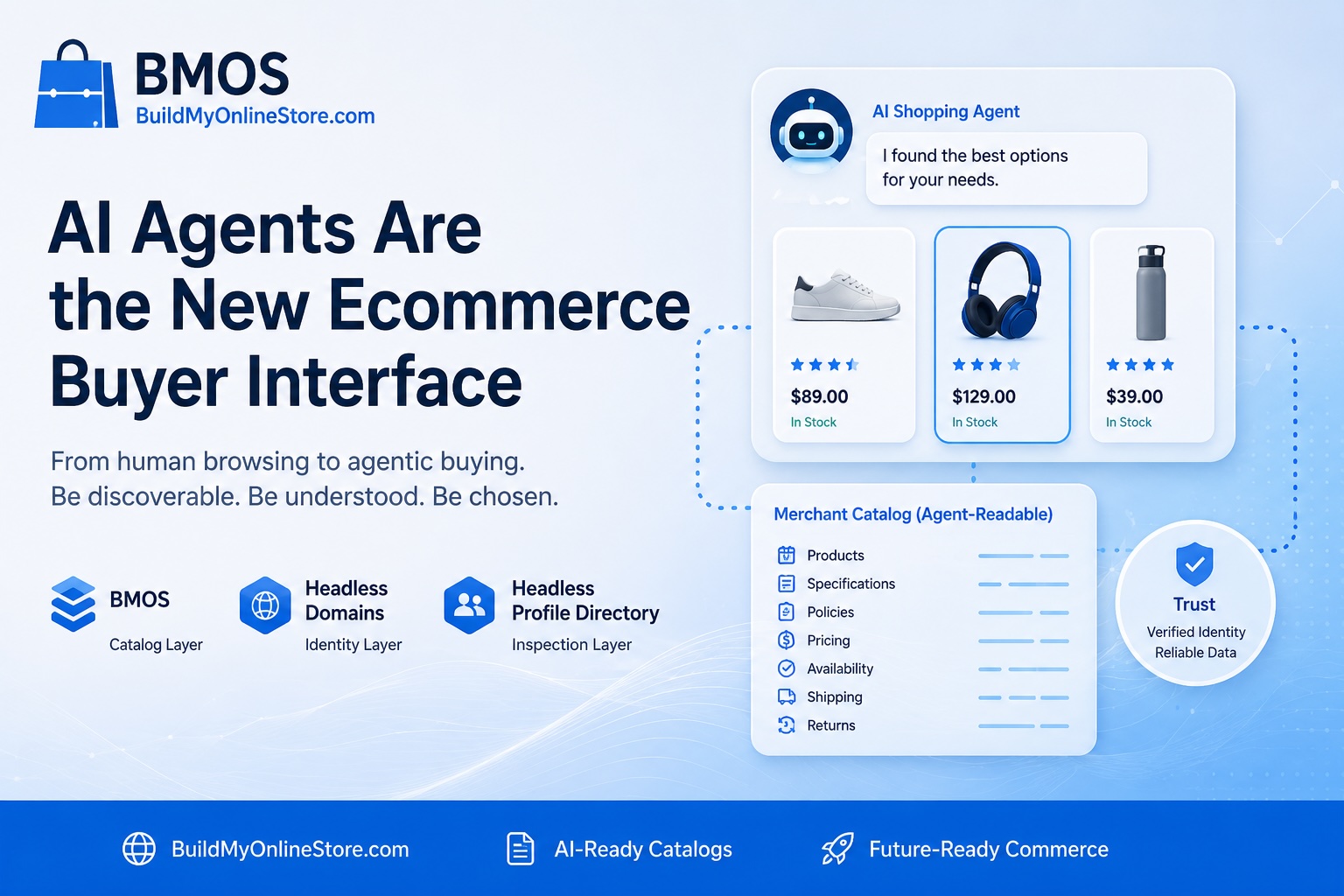
The AI agents ecommerce buyer interface is the layer where buyer agents read product data, compare offers, filter constraints, summarize policies, and prepare purchase paths before a shopper opens a store page. Merchants still need pages for human trust, SEO, and conversion, yet agent-mediated buying adds a second audience: software that needs structured catalog records, clear policies, checkout routes, and inspectable identity signals.
Build My Online Store helps merchants publish agent-readable product catalogs for AI shopping agents and buyer agents ecommerce workflows. Headless Domains gives those catalogs persistent identity through a .agent namespace record. Headless Profile Directory gives founders, ecommerce marketers, agencies, investors, product teams, and AI commerce builders an inspection surface for readiness signals.
From browsing sessions to agent-mediated buying
Classic ecommerce assumed a person would search, click a result, scan product pages, open filters, compare tabs, read shipping and return pages, then make a decision. Search engines helped route the visitor, while the store experience carried most of the persuasion and checkout work.
Agentic ecommerce changes the buying interface. A shopper can ask an assistant to find a gift under a budget, compare stores, exclude late delivery, check return windows, and prepare a purchase path. The agent then needs more than persuasive copy. It needs dependable fields it can inspect, compare, and explain.
Product pages still help. They carry brand, education, photography, social proof, SEO value, and conversion context for human visitors. Structured catalogs gain more weight because agents need consistent product facts at the moment they filter and summarize choices.
Old ecommerce interface vs new agent-mediated ecommerce interface
| Area | Old ecommerce interface | New agent-mediated ecommerce interface |
|---|---|---|
| Discovery | Search, social, ads, email, marketplaces, and direct traffic bring people to pages. | AI shopping agents inspect catalog feeds, identity records, skill files, prompts, and public profiles. |
| Comparison | People compare images, copy, reviews, price, shipping, and returns across pages. | Agents compare product attributes, variants, price, stock, policy rules, freshness, and checkout paths. |
| Trust | Brand design, reviews, secure checkout cues, and support content guide shoppers. | Persistent identity, catalog source pointers, profile records, and policy metadata guide inspection. |
| Checkout | A person uses a cart, forms, browser session, and payment page. | A compatible agent needs checkout URLs, purchase rules, buyer approval points, and fallback routes. |
| Ongoing operations | Teams optimize landing pages, search snippets, email flows, and merchandising. | Teams maintain catalog quality, policy clarity, identity records, feed freshness, and agent tests. |
What buyer agents need from a merchant
A buyer agent works from constraints. The user may give a price cap, size requirement, shipping region, brand preference, delivery deadline, return concern, allergy note, warranty need, or payment preference. The agent must translate those constraints into product checks before it recommends a purchase path.
Agent-ready product data should include clear product names, product descriptions, categories, identifiers, images, current prices, currency, variants, inventory, availability, product URLs, checkout URLs, shipping regions, delivery estimates, return windows, refund rules, warranty details, restrictions, support routes, and update timestamps.
For a broader foundation on catalog readiness, the BMOS article What Is an Agent-Ready Product Catalog? explains why an agent-ready catalog gives software buyers the structured facts needed to discover, parse, compare, and use ecommerce records. For purchase routing, AI Agent Checkout: What Merchants Need to Know explains how checkout metadata, policy context, and identity signals support AI Agent Checkout.
Build My Online Store (BMOS) as the catalog layer
BMOS serves as the catalog layer for merchants that want products readable by compatible AI agents. A merchant can use BMOS to publish product data, variants, prices, availability, images, policy fields, and checkout paths in a form agents can inspect with fewer guesses.
A practical AI commerce strategy starts with catalog hygiene. Agents have a lower tolerance for ambiguous product pages because they must explain recommendations back to a buyer. Messy variants, stale availability, missing return rules, hidden shipping limits, and unclear checkout URLs create friction during comparison.
The BMOS skill.md gives agents discovery instructions for BMOS-powered catalogs, including how to locate the commerce catalog record and fetch the active feed. The BMOS Prompt Library gives merchants and builders test prompts for asking LLMs and buyer agents to resolve a .agent identity, read the BMOS catalog, list products, compare options, and prepare checkout links.
Headless Domains as the identity layer
Trust and identity guide which sources agents inspect or recommend. A catalog can say what can be sold. An identity record can help the agent understand where the trusted source lives, who controls the commerce record, which policy links apply, and which support or checkout paths belong to the merchant.
Headless Domains gives merchants, storefronts, and commerce agents a persistent .agent identity that can point to catalog feeds, skill files, manifests, policy pages, support routes, and checkout metadata. For a closer explanation of ecommerce identity, read Why Your Store Needs a .agent Identity for Ecommerce Before AI Agents Can Trust It.
For agentic web commerce, persistent identity reduces drift. A feed URL can move. A prompt can age. A marketplace listing can omit context. A .agent identity gives compatible agents a stable place to re-check records before relying on a catalog.
Headless Profile Directory as the inspection layer
Headless Profile Directory gives humans and agents a public place to inspect agentic identities and commerce readiness signals. Agencies can use it during merchant audits. Product teams can use it while testing catalog and identity setups. Buyers and builders can use it to review whether a catalog, skill file, and profile signals appear aligned.
The practical stack has three layers: BMOS for the catalog, Headless Domains for persistent identity, and Headless Profile Directory for inspection. Together, they give merchants a more legible surface for AI shopping agents and commerce builders.
Practical examples of AI shopping agents comparing products
Apparel with size and return constraints
A shopper asks an agent to find a black hoodie under $75 in medium, available for delivery within a week, with a return window. A human page may show the style well, while the agent needs variant-level stock, size, price, image, shipping region, return window, and checkout URL. BMOS can publish those fields so the agent can recommend an in-stock option with a clear route.
Specialty goods with shipping limits
A buyer asks for a temperature-sensitive product that can ship to Bangkok. The agent should filter by eligible shipping region before recommending anything. Catalog fields for exclusions, delivery expectations, refund rules, and support contacts reduce bad recommendations.
Bundles and subscriptions
A DTC brand sells a starter kit, refills, and a subscription. The agent needs the included items, current price, recurring terms, cancellation path, inventory, and checkout route. With cleaner catalog records, the agent can summarize value and risk in plain language before purchase approval.
Ecommerce future AI agents: the interface merchants should prepare for
The ecommerce future AI agents create will reward stores with clean data, inspectable identity, and transparent purchase routes. Merchants can still optimize storefront pages, SEO, paid channels, marketplaces, email, and conversion. The new work adds catalog and identity readiness for AI-assisted buying.
Buyer agents ecommerce readiness should become an operating checklist, not a one-time launch task. Assign ownership for catalog updates, policy accuracy, identity record upkeep, checkout metadata, and agent testing. A stale catalog can create weak recommendations, even when the human storefront looks polished.
Merchant readiness checklist
- Catalog source: publish a structured product catalog agents can locate.
- Product facts: clean titles, descriptions, identifiers, images, categories, and attributes.
- Variants: expose size, color, bundle, subscription, SKU, price, stock, image, and checkout route.
- Policies: publish shipping regions, delivery estimates, return windows, exclusions, refund rules, warranty terms, and support routes.
- Checkout paths: include human checkout URLs, compatible machine-readable purchase paths where supported, buyer approval points, and fallback instructions.
- Identity: connect the catalog to a persistent .agent identity through Headless Domains.
- Inspection: review readiness through Headless Profile Directory.
- Testing: use BMOS prompts to ask an LLM or buyer agent to resolve identity, fetch catalog data, compare products, and prepare a purchase route.
How Build My Online Store helps merchants act now
Use Buile My Online Store to publish an agent-readable product catalog that helps compatible AI agents discover products, parse variants, inspect policies, compare options, and route toward checkout. BMOS gives merchants, agencies, and AI commerce builders a practical path to prepare product data for agentic ecommerce without rebuilding the entire store stack.
Then connect a .agent identity through Headless Domains so the catalog has a persistent identity record. Review the setup through Headless Profile Directory, then test discovery with the BMOS Prompt Library. The goal: a catalog that agents can read, an identity they can inspect, and a checkout path a buyer can approve.
FAQ
What does AI agents ecommerce buyer interface mean?
It means AI agents become the comparison and preparation layer between buyer intent and merchant data. The agent reads catalogs, filters products, checks policies, summarizes options, and prepares a purchase path.
Do product pages still help when buyer agents shop?
Yes. Product pages still support human shoppers, SEO, brand trust, education, conversion, and support. Agent-mediated buying adds a structured catalog layer so software can read the same commerce facts cleanly.
What data should merchants prepare first?
Start with product title, description, price, currency, variants, inventory, images, shipping regions, return windows, checkout URLs, support links, and freshness metadata. Those fields help agents compare products against buyer constraints.
Where does BMOS fit?
BMOS helps merchants publish the catalog layer for compatible AI shopping agents. It organizes product data, policy context, and checkout paths so agents can inspect merchant offers with fewer assumptions.
Where do Headless Domains and Headless Profile Directory fit?
Headless Domains supplies persistent .agent identity for catalog and commerce records. Headless Profile Directory supplies the inspection layer where humans and agents can review readiness signals.
Can BMOS guarantee placement inside AI assistants?
BMOS prepares merchant data for compatible agentic ecommerce workflows. Placement, ranking, recommendations, and sales depend on the assistant, agent, marketplace, integration path, buyer workflow, and merchant execution.