
Agent-Readable Catalog vs Marketplace Listing: Why Merchants Need BMOS
May 14, 2026
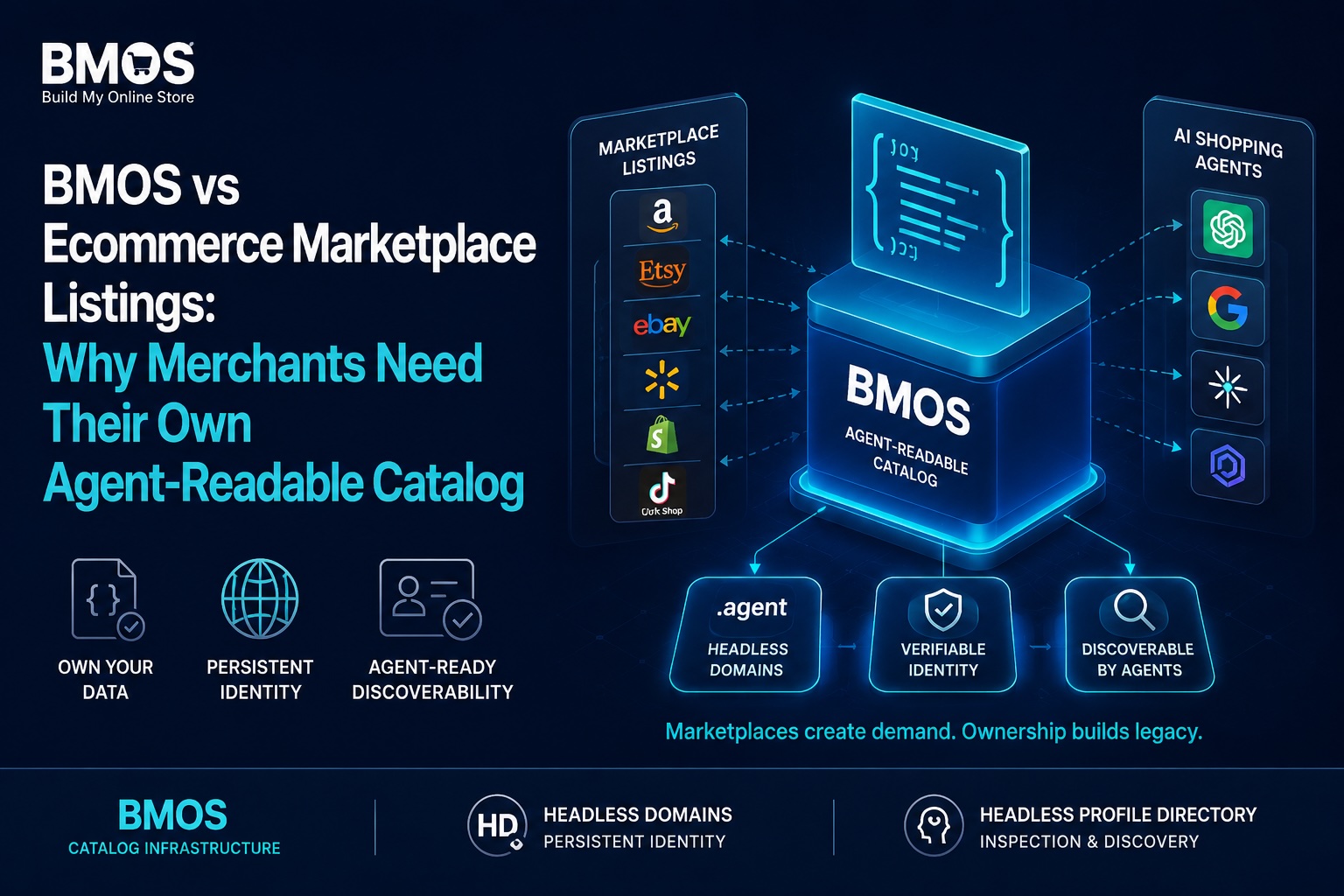
Marketplace listings can help merchants create demand, reach shoppers, and learn which products earn attention. For the agent-readable catalog vs marketplace listing decision, the best answer combines both channels: keep marketplace reach, then publish an owned catalog layer that AI shopping agents can inspect outside any single platform.
BMOS gives merchants that owned product catalog layer for agentic commerce. A BMOS catalog can organize product data, variants, prices, availability, policy context, checkout paths, and merchant metadata so compatible agents have a cleaner source of truth than a marketplace page, storefront theme, or ad feed alone.
BMOS vs marketplace: the core difference
Marketplace pages, Amazon listings, Etsy listings, Shopify product pages, WooCommerce product pages, and DTC storefronts all play useful roles. They serve humans, search engines, marketplaces, payment flows, reviews, and brand presentation. Agentic commerce adds a new surface: AI systems need structured, current, portable product data that can be read, compared, verified, and routed toward purchase.
The BMOS vs marketplace decision should be framed around infrastructure ownership. A marketplace listing sits inside a marketplace. A normal storefront sits inside the merchant site. A BMOS agent-readable catalog gives the merchant a portable commerce record that can travel with the brand across agents, directories, identity records, shopping assistants, and future AI ecommerce marketplace workflows.
Marketplace discovery and owned catalog infrastructure work together
Marketplaces still give merchants valuable distribution. Amazon, Etsy, marketplace ads, category pages, marketplace search, social proof, and buyer reviews can generate demand. BMOS adds a channel merchants control: an agentic commerce catalog that compatible buyer agents can use when a shopper asks for product matches, shipping details, variant comparisons, return rules, or a safe path to checkout.
For merchants, the question becomes: where should AI shopping agents find the source-of-truth catalog? A marketplace page can describe one listing inside one ecosystem. An owned BMOS catalog can describe the merchant’s broader commerce data, including items sold through a storefront, marketplace channels, bundles, subscriptions, policies, and purchase routes.
Marketplace listing vs normal storefront vs BMOS agent-readable catalog
| Commerce surface | Best use | What agents need | Merchant control |
|---|---|---|---|
| Marketplace listing | Demand creation, buyer trust, reviews, marketplace search, and transaction volume. | Current product facts, variant data, merchant identity, policy context, and catalog-level source signals. | Controlled by marketplace rules, ranking systems, templates, fees, and data export limits. |
| Normal storefront | Brand experience, SEO, product education, email capture, conversion, support, and direct customer relationships. | Structured product records, stable checkout paths, machine-readable policies, and identity signals beyond page design. | Higher control, though data may still live across themes, plugins, apps, policy pages, and checkout sessions. |
| BMOS agent-readable catalog | Owned product catalog infrastructure for AI shopping agents, agentic commerce, and portable merchant discovery. | A clean catalog feed with products, prices, variants, availability, policies, checkout routes, metadata, and inspection paths. | Merchant-controlled catalog layer designed to support platform portability and agent-readable commerce workflows. |
Why AI shopping agents need source-of-truth product data
A human can work around messy commerce data. They can zoom into images, compare tabs, find a policy page, pick a size, open a cart, and decide whether a seller feels trustworthy. An AI shopping agent needs data fields it can parse without guessing: product name, description, category, SKU, variant, image, price, currency, stock status, shipping region, return rule, support path, checkout URL, and freshness signal.
BMOS helps merchants publish those facts as an owned catalog rather than scattering them across page copy, marketplace templates, app widgets, plugins, policy pages, and checkout flows. For a fuller catalog primer, read the BMOS guide, What Is an Agent-Ready Product Catalog?.
Why platform portability helps merchants
Marketplace dependence can create fragility. Search rules change. Category ranking changes. Fees change. Review systems change. Listing formats change. Storefront apps change. AI ecommerce marketplace surfaces will also change as buyer agents, catalog protocols, and checkout systems mature.
A portable owned product catalog gives the merchant a durable base. When the same catalog can support a storefront, marketplace strategy, agent-readable feed, identity record, prompt testing, and public inspection, the merchant can adapt without rebuilding product data for every new channel.
How BMOS provides the catalog layer
BMOS focuses on the merchant catalog layer for the agentic web. Merchants can use BMOS to prepare product records that compatible agents can discover, read, compare, and route toward checkout. The catalog can carry product facts, variant details, current pricing, availability, return information, shipping context, support details, and checkout paths.
- Catalog facts: titles, descriptions, images, categories, identifiers, and product URLs.
- Buyable options: variants, SKUs, prices, currency, stock status, and checkout routes.
- Commerce context: shipping regions, return windows, support paths, policy links, and freshness metadata.
The BMOS skill file gives AI agents instructions for discovering BMOS-powered commerce catalogs and using fresh feed data. The BMOS prompt library gives merchants and consultants copy-ready prompts for testing how LLMs and buyer agents inspect catalog data.
How Headless Domains gives the catalog persistent identity
An owned catalog becomes stronger when agents can verify where it lives and who controls it. Headless Domains supplies the persistent identity layer through agent-native namespaces such as .agent. A merchant can connect catalog pointers, skill files, manifests, profile data, support paths, and trusted endpoints to an inspectable identity record.
For merchants planning agentic commerce, the catalog layer and identity layer should work together. BMOS organizes product data. Headless Domains gives the catalog a persistent identity surface. The Headless Domains guide Agentic Commerce for Merchants explains the practical stack of catalog, identity, and inspection for AI shopping agents.
How Headless Profile Directory supports inspection and discovery
Once a merchant has a catalog and identity record, agencies, consultants, buyers, and compatible agents need a public place to inspect readiness signals. Headless Profile Directory provides that inspection and discovery layer for agentic identities.
For ecommerce marketplace AI, inspection can help reduce uncertainty. A buyer agent can evaluate whether a merchant has a connected catalog, an identity record, profile data, support routes, and commerce metadata before recommending a purchase route.
Practical examples
Amazon seller with a direct catalog
An Amazon seller may rely on marketplace demand, reviews, and fulfillment. With BMOS, the same merchant can prepare an owned product catalog that lists current SKUs, variants, bundles, merchant support paths, and direct checkout options where available. Agents can inspect the owned catalog while the merchant keeps marketplace listings active.
Etsy seller with custom variations
An Etsy seller may offer custom colors, sizing, processing times, and handmade constraints. A BMOS catalog can expose those options in structured fields, helping AI shopping agents compare the item against a buyer request without relying on free-form listing copy alone.
Shopify or WooCommerce merchant with variants
A Shopify or WooCommerce store may have clean product pages for humans while variant data sits inside selectors, apps, or theme logic. BMOS can publish buyable variant records with size, color, SKU, price, stock status, image, policy context, and purchase route. The BMOS article How to Make Your Ecommerce Store Readable by AI Agents gives a practical setup path.
DTC brand with bundles and subscriptions
A DTC brand may sell a starter kit, refills, subscription cadence, add-ons, and replacement parts. Agents need itemized contents, recurring terms, cancellation rules, delivery expectations, and support routes. BMOS can turn the offer into a comparison-ready agentic commerce catalog for buyer agents.
Checklist: prepare an owned product catalog for agents
- Clean product titles so agents can identify each item quickly.
- Normalize variants by SKU, size, color, material, bundle, subscription, price, currency, and stock status.
- Add stable product images and clear product descriptions.
- Turn shipping, returns, warranty, and support into structured policy facts.
- Confirm checkout URLs and fallback purchase routes.
- Publish the catalog through BMOS.
- Review the BMOS skill file and prompt library for testing.
- Connect a .agent identity through Headless Domains.
- Use Headless Profile Directory so readiness can be inspected by humans and compatible agents.
Why merchants should use marketplaces and owned catalogs together
Marketplaces can keep generating demand. Storefronts can keep building brand equity and direct customer relationships. BMOS gives merchants a separate, owned product catalog layer for AI shopping agents and agentic commerce workflows. The combination gives sellers more surface area: marketplace discovery, human storefront conversion, and agent-readable catalog infrastructure.
For ecommerce agencies and AI commerce consultants, BMOS creates a practical service opportunity. Teams can audit product data, normalize variants, prepare policy metadata, connect Headless Domains identity records, test LLM prompts, and use Headless Profile Directory as an inspection surface.
CTA: publish your agent-readable catalog with BMOS
Use BMOS to create an owned product catalog that compatible AI shopping agents can discover, parse, compare, and route toward purchase. Start with your highest-value products, clean the data, expose the policy context, and make the catalog portable beyond any single marketplace.
As the secondary step, connect a .agent identity through Headless Domains so the catalog has a persistent identity record agents can inspect. Then surface readiness through Headless Profile Directory for discovery and verification.
FAQ
What is the difference between an agent-readable catalog and a marketplace listing?
A marketplace listing presents a product inside one marketplace. An agent-readable catalog gives compatible AI agents structured product data, policy context, checkout paths, and merchant identity signals from an owned source.
Does BMOS replace Amazon, Etsy, Shopify, or WooCommerce?
BMOS works beside those channels. Merchants can keep marketplace listings and storefronts while using BMOS as the catalog layer for agentic commerce.
Why do AI shopping agents need structured product data?
Agents need to compare products against buyer constraints. Structured fields for price, variant, availability, shipping, returns, support, identity, and checkout reduce guessing.
How does Headless Domains support BMOS catalogs?
Headless Domains gives the merchant or catalog a persistent .agent identity that can point agents to catalog feeds, skill files, manifests, support links, profile data, and trusted endpoints.
What does Headless Profile Directory add?
Headless Profile Directory gives humans and compatible agents a public inspection and discovery surface for agentic identities, including commerce readiness signals.
Who should use BMOS?
BMOS is useful for marketplace sellers, Shopify merchants, WooCommerce merchants, Amazon sellers, Etsy sellers, DTC brands, ecommerce agencies, and AI commerce consultants preparing for agentic commerce.
Can BMOS guarantee placement inside AI assistants?
BMOS prepares catalog data for compatible agents and workflows. Placement, ranking, recommendations, and sales depend on external systems, buyer intent, product fit, pricing, trust, and channel dynamics.
What should merchants clean first?
Start with product titles, descriptions, SKUs, variants, prices, availability, images, shipping regions, return rules, support links, checkout URLs, and identity signals.