
How to Get Your Products Discovered by ChatGPT, Claude, Gemini, and Buyer Agents
May 8, 2026
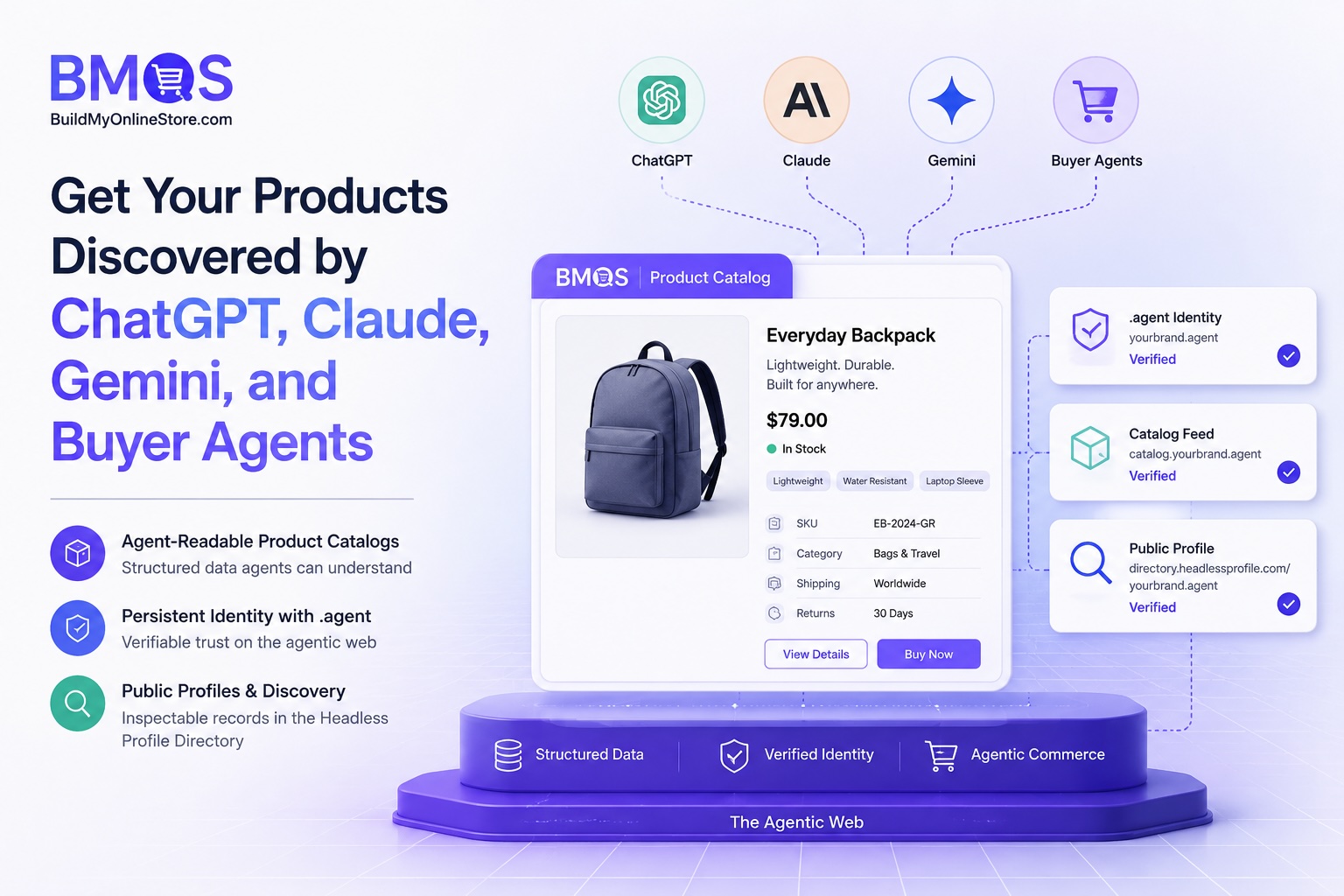
Merchants are starting to ask a new version of an old ecommerce question: how do we get found?
For years, the answer was mostly search, marketplaces, social platforms, paid media, email, and affiliates. Those channels still matter. But a new discovery surface is emerging as buyers ask ChatGPT, Claude, Gemini, and specialized buyer agents to research products, compare options, check policies, and sometimes help complete purchases.
The important point is this: merchants should not think of this as “ranking inside ChatGPT.” Closed AI systems decide what they retrieve, cite, summarize, recommend, or transact with. No merchant, feed, schema, directory, or identity product can guarantee model inclusion, product recommendations, rankings, traffic, sales, or checkout volume.
The practical goal is narrower and more useful: make your products discoverable, readable, comparable, verifiable, and purchasable by compatible agents.
That is where BMOS fits. BMOS helps merchants publish an agent-readable product catalog for the agentic web. Headless Domains gives merchants and commerce agents a persistent, verifiable identity layer. Headless Profile Directory gives humans and machines a public inspection layer for those identity records.
What “get products discovered by AI agents” really means
When merchants search for phrases like “sell products in ChatGPT,” “products in Claude,” “products in Gemini,” “AI shopping optimization,” “LLM ecommerce optimization,” or “AI product discovery,” they are usually asking one of three questions:
- Can AI systems understand what I sell?
- Can buyer agents compare my products accurately?
- Can a compatible agent find a trusted path from product discovery to checkout?
Those are not the same as traditional SEO rankings. Traditional SEO is largely about helping search engines crawl, index, rank, and display pages. Agent discovery is about helping software understand your catalog as operational data: what the product is, what it costs, whether it is available, where it ships, what policies apply, and what action can happen next.
Official guidance from Google reinforces the same caution merchants should apply here. Google says foundational SEO still matters for generative AI search, technical clarity helps discovery and indexing, and indexing or serving is not guaranteed. Google also says merchants should maintain ecommerce details and product data through tools like Merchant Center where appropriate. You can read Google’s current guidance on optimizing for generative AI features on Google Search.
For ChatGPT, OpenAI documents separate crawler and user-agent behavior, including OAI-SearchBot for search, GPTBot for model training, and ChatGPT-User for certain user-triggered actions. That matters because crawler access, training access, and user-requested retrieval are different things. Review OpenAI’s crawler documentation before making assumptions about visibility.
For Claude, Anthropic documents ClaudeBot, Claude-User, and Claude-SearchBot separately, with different purposes for model development, user-requested retrieval, and search. Review Anthropic’s crawler guidance when deciding how your robots.txt policy should treat Claude access.
Human SEO vs agent discovery
| Area | Human SEO | Agent discovery |
|---|---|---|
| Primary audience | Search engines and human shoppers | AI systems, buyer agents, commerce agents, and human reviewers |
| Main asset | Product pages, category pages, content, links, reviews | Structured catalog feed, identity records, policy metadata, checkout paths |
| Optimization goal | Earn visibility, clicks, and conversions from search results | Help compatible agents read, compare, verify, and route products correctly |
| Trust signals | Brand, reviews, HTTPS, policies, backlinks, merchant reputation | Persistent identity, verified records, source-of-truth feed, declared policies, current endpoints |
| Risk | Low rankings, low click-through rates, poor conversion | Agents misread products, skip incomplete data, distrust unclear sellers, or fail to find checkout |
What merchants can actually control
You cannot control whether ChatGPT, Claude, Gemini, Google AI Mode, a marketplace agent, or a custom buyer agent chooses to recommend your product. You can control whether your product data is easy to inspect and less likely to be misunderstood.
1. Structured product data
AI systems do better when product facts are explicit. At minimum, your catalog should include product name, description, brand, SKU, category, images, price, currency, variants, availability, shipping regions, return policy, support contact, and checkout URL.
This is not only an AI issue. Schema.org Product defines a broad vocabulary for product and service information, and Google’s Product structured data documentation explains how price, availability, reviews, shipping, and returns can help product information appear in richer ways across Google Search experiences.
BMOS is designed to help merchants publish this kind of catalog layer in a machine-readable way. Instead of asking every merchant to build a custom agentic commerce feed from scratch, BMOS provides a merchant-friendly path for publishing structured product data for compatible agents.
2. Catalog freshness
Agents need current data. A stale price, missing variant, expired offer, or out-of-stock product can create a poor buyer experience. The more your catalog becomes part of agentic commerce workflows, the more important freshness becomes.
A good agent-readable catalog should make freshness obvious. Include last-updated timestamps, current availability, valid prices, active checkout links, and clear status for discontinued or backordered products.
3. Policy clarity
Many buyer decisions depend on constraints. A buyer agent may need to know whether a product ships to a country, whether returns are free, whether a warranty applies, whether there is a subscription, whether the product has age or compliance restrictions, or whether final sale rules apply.
Do not bury those facts inside image banners, accordion-only copy, or vague legal pages. Give agents clear fields and plain-language policy summaries. A buyer agent comparing two products may choose the product it can explain with confidence.
4. Identity verification
In agentic commerce, product data is only one part of trust. Agents also need to know who controls the catalog, where the official record lives, which endpoints are trusted, and whether the seller or commerce agent can be inspected later.
Headless Domains provides the persistent identity layer for this problem. The Headless Domains article AI Just Created a New Ecommerce Org Chart explains the emerging ecommerce roles around AI-agent discoverability, structured catalogs, machine-ready checkout paths, trust signals, and identity records. The article How to Make Your API Agent-Ready expands the same idea for APIs, endpoints, permissions, payments, documentation, and verification.
A .agent identity through Headless Domains can act as the persistent record connected to your merchant, catalog, or commerce agent. The goal is not to replace your store. The goal is to give agents a stable identity record they can inspect across the agentic web.
5. Checkout readiness
Discovery without a clear next step is incomplete. If an agent can understand a product but cannot identify the checkout path, stock status, shipping constraints, or payment rules, the journey may break.
Agentic commerce standards are evolving quickly. Stripe documents the Agentic Commerce Protocol as an open standard for enabling AI agents to complete purchases on behalf of buyers, and Google documents the Universal Commerce Protocol for agentic commerce actions in Google Search AI Mode and Gemini. Merchants should treat these developments as a signal: product data, checkout state, identity, and policy data are becoming part of the same commerce surface.
6. Source-of-truth feeds
Agents should not have to guess which page, spreadsheet, feed, API, or marketplace listing is correct. Create one authoritative product source, then keep it synchronized with your storefront, policies, inventory, and identity records.
BMOS gives merchants a practical catalog layer for this job. The BMOS skill file explains how compatible agents can discover and inspect BMOS-powered merchant catalogs. The BMOS prompt library gives example prompts that humans and agents can use to test discovery flows.
The BMOS, Headless Domains, and Headless Profile Directory stack
For merchants preparing for agentic commerce, the stack is simple:
- BMOS is the product catalog layer. It helps publish agent-readable product, price, variant, policy, and checkout information.
- Headless Domains is the persistent identity layer. It helps merchants and commerce agents declare a stable identity record that can be inspected and verified.
- Headless Profile Directory is the inspection layer. It provides a public surface where humans and machines can inspect agentic identity records.
This combination helps answer the questions a buyer agent may ask before recommending or routing a purchase:
- What products are available right now?
- What do they cost?
- What variants exist?
- What policies apply?
- Where is the trusted checkout path?
- Who controls this merchant or commerce agent?
- Where can the identity record be inspected again later?
Practical examples: prompts buyers and agents might use
Merchants should test how their catalog behaves when a buyer or agent tries to inspect it. Here are example prompts that reflect realistic agent discovery behavior.
Simple catalog inspection
Check this merchant’s BMOS catalog and list the products available right now. Include product names, prices, variants, availability, and checkout links where available.
Product comparison
Act as my buyer agent. Compare the products in this BMOS-powered catalog against my requirements: under $100, ships to the United States, returnable within 30 days, and suitable as a gift. Explain which product is the strongest match and why.
Policy inspection
Inspect the merchant’s agent-readable catalog and summarize the shipping, return, support, and checkout policies. Flag anything unclear before recommending a purchase.
Identity and trust check
Check the merchant’s .agent identity record through Headless Domains and Headless Profile Directory. Confirm the official catalog feed, declared endpoints, and public profile before using product data.
These prompts do not force an AI system to recommend a product. They help you test whether your catalog and identity records are understandable enough for compatible agents to work with them.
Why clean data improves AI product discovery
Clean product data reduces ambiguity. If your product title is vague, your variant names are inconsistent, your availability is hidden, your policies conflict, or your checkout URL is missing, an agent has to infer too much.
Inference creates risk. An AI system might summarize the wrong feature, compare the wrong variant, miss a shipping restriction, cite an old price, or skip the product because another merchant provides clearer data.
Clean data gives agents a better chance of understanding products correctly. It also helps humans. The same catalog work that improves AI shopping optimization often improves conventional ecommerce operations: fewer support questions, clearer merchandising, better feed quality, cleaner product pages, and more consistent marketplace listings.
An agent discovery checklist for merchants
- Publish structured product data: title, description, brand, SKU, category, images, price, currency, variants, and availability.
- Keep the catalog fresh: update prices, stock, discontinued products, and checkout URLs.
- Make policies explicit: shipping, returns, warranty, subscriptions, restrictions, support, and cancellation rules.
- Use a source-of-truth catalog: avoid conflicting data across your store, feeds, marketplaces, and AI-readable files.
- Check crawler access: review robots.txt and AI crawler policies for the systems you care about.
- Add product structured data: use Schema.org and follow Google’s merchant listing guidance where relevant.
- Prepare checkout paths: provide human checkout URLs and machine-readable checkout metadata where supported.
- Claim or connect identity: use Headless Domains to connect your merchant, catalog, or commerce agent to a persistent .agent identity.
- List for inspection: make your record visible through Headless Profile Directory where appropriate.
- Test with prompts: ask ChatGPT, Claude, Gemini, and buyer agents to inspect, summarize, and compare your catalog.
What not to do
Do not chase “AI ranking hacks.” Do not create fake mentions, doorway pages, duplicate AI pages, or misleading product data. Do not claim your products are available inside an AI system unless the integration, feed, or platform support is actually live. Do not imply that BMOS, Headless Domains, Headless Profile Directory, schema, robots.txt, ACP, UCP, or any other standard guarantees sales.
Instead, focus on durable readiness: structured data, freshness, crawlability, policy clarity, identity verification, and checkout readiness.
Use BMOS to publish an agent-readable catalog
If you want your products to be easier for compatible buyer agents to understand, start with the catalog. BMOS helps merchants publish agent-readable product catalogs for the agentic web, including product data, policies, and discovery instructions that agents can inspect.
Use BMOS as your product catalog layer, then connect it to a persistent identity record so agents can verify where the catalog came from.
Start with BMOS and prepare your product catalog for AI product discovery.
Claim or connect a .agent identity through Headless Domains
Once your catalog is readable, give it a trusted identity surface. Headless Domains helps merchants and commerce agents create persistent, verifiable identity records for the agentic web. A .agent identity can point to your catalog, profile, operating instructions, and trusted commerce endpoints.
Then use Headless Profile Directory as the inspection layer so humans and compatible agents can review the public record.
Claim or connect your .agent identity through Headless Domains.
FAQ
Can BMOS guarantee that my products appear in ChatGPT, Claude, or Gemini?
No. BMOS helps merchants publish agent-readable product catalogs, but it does not control closed AI recommendation systems, model behavior, rankings, citations, or sales.
What is the best way to get products discovered by AI agents?
The best starting point is to publish clean, structured, fresh product data that compatible agents can inspect. Include product details, price, availability, variants, policies, checkout paths, and a trusted identity record.
Is this the same as SEO?
No, but SEO still matters. Traditional SEO helps search engines and shoppers discover pages. Agent discovery focuses on making products and policies readable, comparable, verifiable, and actionable for software agents.
Do I need Schema.org product markup?
Schema.org product markup is a useful part of ecommerce SEO and product clarity. It should not be your only strategy, but it helps define product facts in a structured format that search systems can understand.
What is BMOS in this stack?
BMOS is the product catalog layer. It helps merchants publish structured, agent-readable product catalog data for compatible AI systems and buyer agents.
What is Headless Domains in this stack?
Headless Domains is the persistent identity layer. It helps merchants and agents maintain verifiable identity records that can point to catalogs, manifests, endpoints, instructions, and profile data.
What is Headless Profile Directory?
Headless Profile Directory is the public inspection layer. It gives humans and machines a place to inspect agentic identity records connected to the Headless Domains ecosystem.
How should I test my catalog?
Ask ChatGPT, Claude, Gemini, or another buyer agent to inspect your catalog, summarize products, compare variants, check policies, and identify the checkout path. The goal is to find missing or confusing data before real buyers encounter it.
Is “AI shopping optimization” mostly about prompts?
No. Prompts are useful for testing, but durable AI shopping optimization starts with better data infrastructure: structured catalogs, clear policies, reliable feeds, verified identity, and checkout readiness.
Should every merchant prepare for agentic commerce now?
Merchants do not need to rebuild everything at once. A practical first step is to make the product catalog agent-readable, keep it fresh, and connect it to a trusted identity record that compatible systems can inspect.