
How Agencies Can Make Client Stores Agent-Ready
May 16, 2026
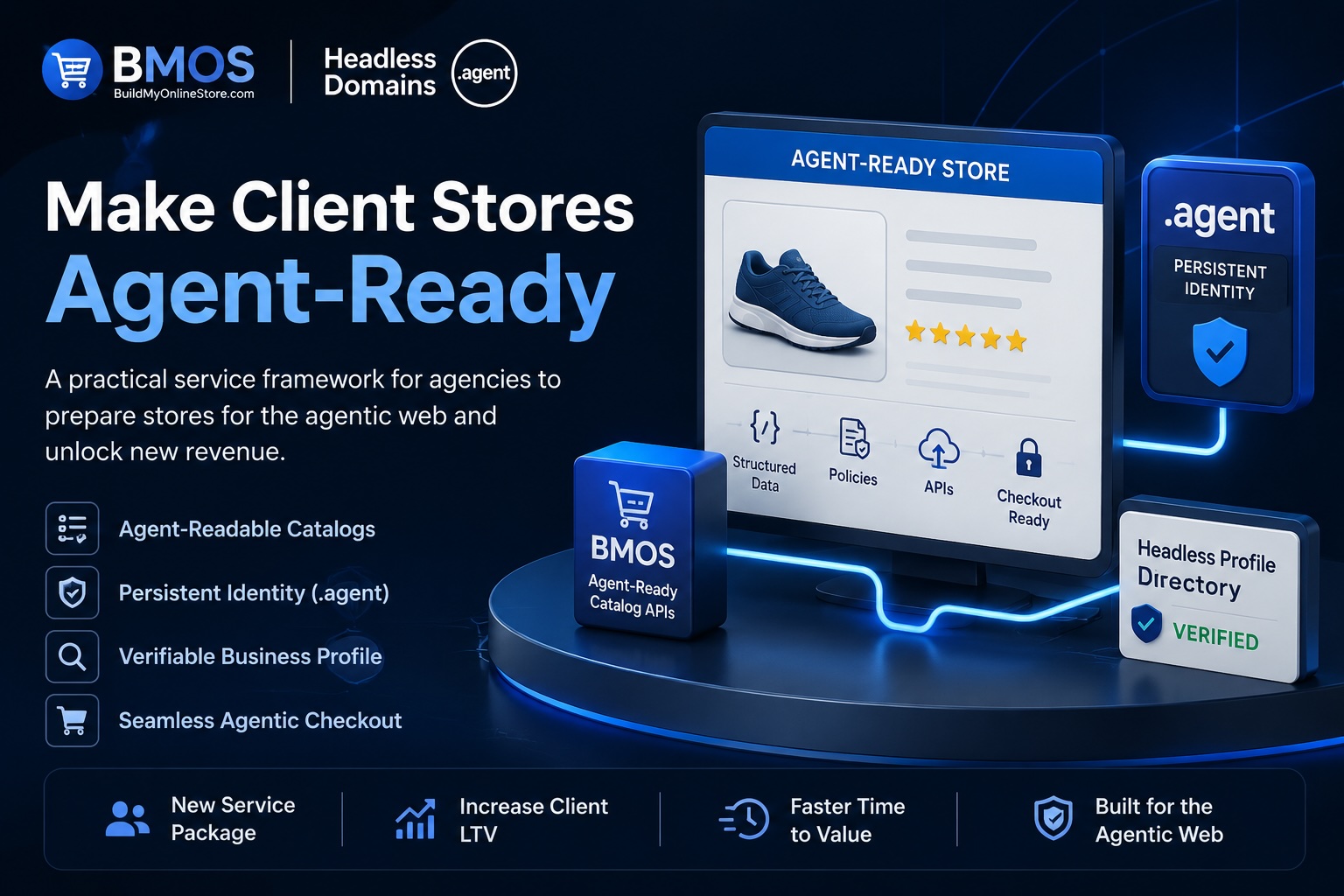
Agencies can make client stores agent-ready by packaging product data cleanup, BMOS feed setup, policy work, checkout checks, .agent identity, public inspection, and prompt testing into a repeatable service. For ecommerce agencies, SEO agencies, AI automation consultants, Shopify developers, WooCommerce developers, and fractional commerce teams, agentic commerce readiness can become a practical retainer add-on built around clean catalog data and verifiable commerce records.
The service opportunity starts with one simple client problem: AI shopping agents need organized facts before they can inspect products, compare options, check policies, and route a buyer toward checkout. BMOS gives agencies a catalog layer for the agentic web, Headless Domains gives merchants a persistent identity layer, and Headless Profile Directory gives teams an inspection layer for readiness signals.
Why agencies should build an agentic commerce readiness offer now
Client stores already invest in SEO, paid shopping feeds, CRO, email, marketplaces, analytics, and merchandising. AI-ready ecommerce adds another operational surface: product catalogs must become easier for compatible agents to discover, read, verify, and use. A buyer may ask an assistant to find a product under a budget, confirm shipping, compare return windows, and prepare a purchase route. An agency with a structured offer can help the client reduce ambiguity across product data, policy language, checkout paths, and identity records.
BMOS positions the work as an AI ecommerce agency service with measurable deliverables. Instead of selling vague AI visibility, agencies can sell an audit, a cleanup sprint, a BMOS feed setup, a prompt test report, and ongoing catalog monitoring. The BMOS guide to product feed optimization for AI agents supports the feed-cleanup side, while The Merchant AI Visibility Checklist for Ecommerce gives teams a scorecard model for readiness reviews.
The agency service package
An agentic commerce agency package should cover the full route from catalog facts to public inspection. The goal: give compatible agents a cleaner source for product facts, merchant identity, policy context, and checkout instructions. The package can run as a one-time implementation, a monthly operations retainer, or an upsell attached to Shopify, WooCommerce, SEO, or paid shopping work.
- Product data audit. Review titles, descriptions, categories, identifiers, images, variants, prices, availability, and update signals. Flag missing SKUs, vague descriptions, duplicate records, stale items, and hidden variant data.
- Catalog cleanup. Rewrite product facts in structured, factual language. Add use cases, compatibility, dimensions, included items, exclusions, subscription details, bundles, and variant-level purchase information.
- BMOS feed setup. Use BMOS to publish a structured catalog feed with product data, policy metadata, checkout routes, and agent-readable records. Link the client to the BMOS skill file so agents and testers know how discovery should work.
- Policy cleanup. Convert shipping, returns, warranty, final-sale rules, support routes, and dispute paths into clear fields or stable policy links that agents can inspect before recommending a product.
- .agent identity setup. Connect a persistent .agent identity through Headless Domains so catalog source, support links, skill files, profile records, and approved endpoints can share one verifiable namespace record.
- Headless Profile Directory inspection. Add or check the profile listing so clients, agencies, and compatible agents can inspect readiness signals tied to the identity record.
- Checkout readiness. Test human checkout links, variant checkout links, product eligibility, payment routes, fallback instructions, and buyer approval steps. Pair the work with BMOS checkout metadata where supported.
- AI prompt testing. Use the BMOS prompt library to test discovery, product summaries, price checks, category requests, comparison prompts, and checkout-routing flows.
Suggested deliverables for clients
A strong AI commerce service package needs outputs clients can review. Agencies should avoid black-box AI claims and deliver concrete work products tied to store operations.
- Agentic commerce readiness audit with pass, fix, and priority labels.
- Product data cleanup spreadsheet or ticket list for top products and collections.
- BMOS feed setup summary with feed URL, owner, update cadence, and test status.
- Policy cleanup notes covering shipping, returns, warranty, exclusions, support, and disputes.
- .agent identity checklist with namespace record, catalog pointer, skill file, and profile route.
- Headless Profile Directory listing or readiness check screenshot, URL, and issue notes.
- Checkout readiness report for product pages, variant routes, carts, and machine-readable paths where supported.
- Prompt testing log with prompts used, responses reviewed, gaps found, and next fixes.
Service tiers agencies can sell
Agencies can start small and expand as client catalogs mature. A three-tier model keeps scope easy to explain and gives clients a path from audit to operations.
Tier 1: Agent-ready audit
Best for clients seeking a fast view of readiness. Review 20 to 50 priority products, core policy pages, checkout links, and identity status. Deliver a scorecard, gap list, and implementation plan. The offer fits SEO agencies, technical marketers, and AI consultants adding a new audit to existing retainers.
Tier 2: BMOS launch package
Best for Shopify, WooCommerce, and catalog-heavy clients ready to publish an agent-readable catalog setup. Clean priority products, configure BMOS, connect the skill file, prepare policy fields, verify checkout routes, connect a .agent identity through Headless Domains, and run prompt tests. The deliverable becomes a launch-ready BMOS for agencies implementation.
Tier 3: AI commerce operations retainer
Best for brands with frequent product launches, inventory changes, seasonal promotions, bundles, or multiple storefronts. Monitor feed quality, product freshness, policy changes, checkout routes, prompt behavior, and inspection signals. Deliver monthly readiness reporting plus sprint recommendations for catalog and policy improvements.
Agency service component table
| Agency service component | Client outcome | BMOS or Headless Domains role |
|---|---|---|
| Product data audit | Cleaner titles, descriptions, identifiers, images, variants, prices, and stock fields. | BMOS helps organize product fields for agent-readable catalog publishing. |
| Catalog cleanup | Products become easier for compatible agents to compare against buyer constraints. | BMOS supplies the catalog layer agencies can manage for clients. |
| Policy cleanup | Shipping, returns, warranty, support, and exclusions become easier to inspect. | BMOS can expose policy metadata and stable references inside the commerce layer. |
| BMOS feed setup | Client has a structured feed for compatible agentic commerce workflows. | BMOS powers the product catalog layer and supports agent-readable records. |
| .agent identity setup | Catalog, skill file, support route, and profile record can connect to a persistent namespace identity. | Headless Domains anchors the identity layer for the agentic web. |
| Headless Profile Directory check | Humans and compatible agents can inspect profile and readiness signals. | Headless Profile Directory supplies the public inspection layer. |
| Checkout readiness | Purchase routes, fallback paths, and approval points become clearer. | BMOS can expose checkout metadata, while Headless Domains helps verify trusted endpoints. |
| AI prompt testing | Agency can show evidence of discovery tests, product summaries, and gaps. | BMOS prompt library gives repeatable tests for discovery and catalog inspection. |
Practical examples agencies can use
Example: Shopify apparel store
A Shopify apparel client has strong brand pages but weak variant data. The agency audits the top 100 products, adds size and color variant IDs, normalizes availability, writes factual product descriptions, adds return rules for final-sale items, publishes a BMOS feed, connects the .agent identity, and tests prompts asking for in-stock products by color, size, budget, and shipping region.
Example: WooCommerce specialty merchant
A WooCommerce client sells products with restrictions and warranty conditions. The agency maps shipping regions, product constraints, warranty limits, support contact, and return exclusions into structured catalog and policy fields. BMOS provides the agent-readable catalog setup, Headless Domains connects the persistent identity, and Headless Profile Directory helps the client inspect the published signals.
Example: SEO agency expanding into AI-ready ecommerce
An SEO agency already audits metadata, schema, internal links, and shopping feed hygiene. The agency adds agent-readable catalog setup, .agent identity checks, and AI prompt testing. The offer becomes an AI commerce service package aligned with existing SEO and feed-management work.
How BMOS helps agencies operationalize the offer
BMOS helps agencies convert strategy into process. Instead of building custom feeds for each client from scratch, teams can use BMOS as the product catalog layer for compatible AI agents. Agencies can standardize intake forms, product cleanup tasks, field mapping, launch checks, prompt tests, and monthly reports around one workflow.
For store teams, BMOS reduces implementation friction by focusing on the data agents need: titles, descriptions, variants, images, pricing, availability, policies, checkout paths, and catalog metadata. For agencies, BMOS turns agentic commerce readiness into a repeatable scope with clear responsibilities across merchant, developer, SEO, and AI consultant roles.
For technical background on the identity side, agencies should read Why Your Store Needs a .agent Identity for Ecommerce Before AI Agents Can Trust It. The article explains how BMOS covers catalog data while Headless Domains anchors persistent identity records for merchants and commerce workflows.
Positioning language agencies can use
Use precise, non-hype language in proposals and sales pages. A safe claim: “We prepare your product catalog, policies, checkout routes, and identity signals so compatible AI agents can inspect your store with fewer assumptions.” Avoid ranking promises, traffic guarantees, and claims about guaranteed inclusion in any assistant or marketplace.
For lead generation, position the offer around these phrases: agentic commerce agency, AI ecommerce agency service, BMOS for agencies, AI-ready ecommerce, agent-readable catalog setup, and AI commerce service package. Each phrase maps to a concrete deliverable rather than a vague AI promise.
Clear CTA for agencies
Use BMOS to launch the catalog layer for client stores. Start with one priority client, clean the top products, publish the feed, test discovery through the skill file and prompt library, and turn the workflow into a repeatable service package.
As a secondary step, connect the client store to a persistent .agent identity through Headless Domains. Then use Headless Profile Directory to inspect the profile and readiness signals tied to the identity.
FAQ
What does it mean to make client stores agent-ready?
It means preparing product data, variants, prices, policies, checkout paths, identity records, and inspection signals so compatible AI agents can discover, read, verify, compare, and route products with fewer assumptions.
Which clients should agencies start with?
Start with clients that have clean operations, steady inventory, clear policies, and enough catalog value to benefit from better product discovery. Shopify, WooCommerce, DTC, B2B catalog, specialty retail, and bundle-heavy stores are good candidates.
Does BMOS replace Shopify or WooCommerce?
BMOS works as a catalog layer for agentic commerce. Client storefronts, carts, merchandising tools, apps, analytics, and back-office systems can continue serving their current roles while BMOS exposes cleaner commerce data for compatible agents.
What role does Headless Domains play?
Headless Domains provides the persistent identity layer. A .agent identity can point to the catalog feed, skill file, support routes, policy links, profile records, and trusted endpoints that agents may inspect.
What role does Headless Profile Directory play?
Headless Profile Directory provides an inspection layer. Agencies can use it to check whether an identity and profile expose the readiness signals clients expect to show.
How should agencies price the service?
Price by catalog complexity, product count, platform, policy cleanup needs, identity setup, and testing scope. Many agencies can start with an audit fee, add a BMOS launch package, then offer monthly catalog operations.
Can agencies guarantee AI rankings or sales from agentic commerce readiness?
Agencies should avoid guarantees. The responsible offer prepares product data, catalog feeds, identity, policy context, checkout routes, and tests so compatible agents can inspect the store with fewer assumptions.