
BMOS vs Google Product Feed: Which Product Feed Helps Merchants Sell to AI Shopping Agents?
May 18, 2026
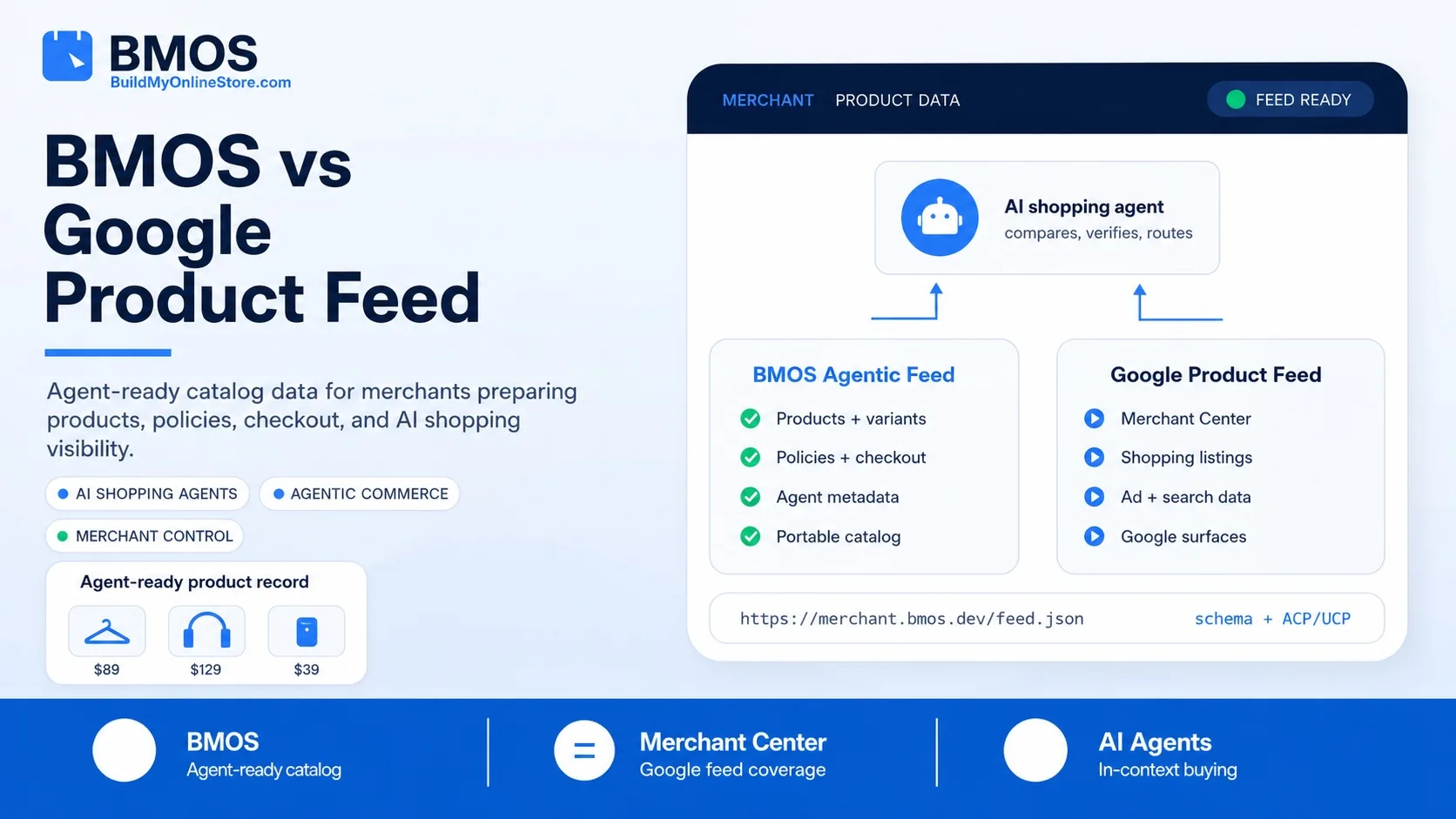
BMOS vs Google Product Feed is a comparison between two product data layers merchants now need to understand. A Google Product Feed helps products qualify for Google Shopping ads, free listings, Merchant Center programs, and Google surfaces. A BMOS agentic feed helps AI shopping agents inspect products, compare variants, read policies, and guide buyers toward checkout across agentic commerce workflows.
The strongest merchant setup uses both. Google Product Feed serves Google demand. BMOS adds an agent-readable catalog built for ChatGPT, Gemini, Claude, Grok, and other AI shopping agents. Merchants searching for an AI product feed, an agentic commerce catalog, or a way to make ecommerce products visible to AI agents should treat BMOS as a catalog readiness layer, not as a replacement for Google Merchant Center.
Why product feeds are changing for AI shopping agents
Classic product feeds were built for search engines, ad systems, and marketplaces. AI shopping agents need more than title, price, image, and availability. Agents also need product options, variant rules, shipping terms, return policies, support details, checkout paths, and merchant identity signals in a format software can inspect without guessing.
Google has also moved commerce toward agent actions. Universal Commerce Protocol (UCP) is described by Google as an open standard for direct buying across AI Mode in Google Search and Gemini. Google also announced 2026 Merchant Center product data changes with more shipping attributes at the product level. For merchants, the message is clear: product data quality now affects both Shopping visibility and AI-assisted purchase paths.
What is a Google Product Feed?
A Google Product Feed is structured product data sent to Google Merchant Center through a file, Google Sheets, scheduled fetch, Content API, or Merchant API. Google uses product data to match merchant products to relevant queries, power Shopping ads and free listings, and check whether catalog details match landing pages and checkout.
Important Google attributes include product ID, title, description, link, image link, price, availability, brand, GTIN or MPN where applicable, condition, shipping, tax, and variant attributes such as item group ID, size, color, material, and pattern. Google also expects consistency across the feed, product page, structured data, cart, and checkout.
What is the BMOS agentic feed?
BMOS, short for Build My Online Store, is an agentic commerce catalog layer for merchants. BMOS publishes product, price, variant, policy, checkout, and agent metadata as a standardized JSON catalog feed with schema.org plus ACP and UCP extensions.
BMOS also supports merchant-controlled catalog distribution. A merchant can build or connect a catalog, enable in-context selling for AI agents, and publish a feed that agents can inspect. BMOS can also sync a catalog to a .agent record through Headless Domains, giving compatible agents a stable identity path for merchant and catalog discovery.
BMOS agentic feed vs Google Product Feed
| Aspect | Google Product Feed | BMOS agentic feed |
|---|---|---|
| Primary purpose | Submit product data to Google Merchant Center for Shopping ads, free listings, and Google merchant surfaces. | Publish an agent-readable catalog for AI shopping agents, product comparison, and agentic checkout workflows. |
| Main audience | Google shoppers, Google Search, Shopping placements, free listings, Performance Max, and Merchant Center programs. | AI shopping agents, buyer assistants, commerce agents, catalog inspectors, and agentic web workflows. |
| Format | XML, TSV, Google Sheets, scheduled fetch, Content API, or Merchant API product data. | JSON catalog feed using schema.org plus ACP, UCP, policy, identity, and checkout metadata. |
| Key data | ID, title, description, link, image link, price, availability, brand, product identifiers, condition, shipping, tax, and variants. | Products, variants, current price, current availability, images, refund policy, terms, agent metadata, and checkout links. |
| Discovery model | Google matches feed data to searches, ads, listings, and merchant experiences. | Compatible agents inspect catalog endpoints, parse structured records, compare options, and route buyers toward purchase. |
| Checkout model | Usually sends shoppers to the merchant site. UCP expands direct buying for supported Google AI surfaces. | Supports human checkout links and machine-ready checkout paths for agent-guided purchase flows. |
| Trust model | Merchant Center verification, policy compliance, landing page consistency, product data accuracy, and account history. | Merchant profile, catalog inspection, policy clarity, checkout metadata, and .agent identity records where configured. |
| Data freshness | Scheduled feed updates, automatic item updates, and API updates depending on setup. | Hosted endpoint designed for on-demand catalog inspection with current pricing, variants, images, and availability. |
| Portability | Optimized for Google channels and Google rules. | Designed as a merchant-controlled catalog layer across compatible agents, protocols, and commerce surfaces. |
| Best use case | Merchants seeking Google Shopping traffic, ad performance, free listings, and Merchant Center growth. | Merchants preparing products for AI shopping agent discovery, comparison, policy review, and purchase assistance. |
The main difference for ecommerce teams
Google Product Feed is a distribution feed for Google. BMOS is an agentic catalog layer for AI shopping agents. Google Product Feed answers, “Can Google understand and list my products?” BMOS answers, “Can a buyer agent inspect my products, verify purchase terms, choose a variant, and continue to checkout?”
Google Merchant Center rewards clean product data, complete identifiers, correct variants, strong images, and accurate price and availability. AI shopping agents need those same basics, plus clearer policy fields, agent instructions, checkout paths, and merchant identity metadata.
When merchants should use Google Product Feed
Use Google Product Feed when Google Shopping, Search visibility, Shopping ads, free listings, and Merchant Center programs matter. Most ecommerce stores should keep the Google feed clean before adding any new AI commerce layer.
Focus on exact titles, complete descriptions, GTINs, variant groups, high-quality images, current price, current availability, shipping details, return policy consistency, and landing page alignment. Google Search Central also says Product and Offer structured data can qualify product pages for merchant listing experiences such as shopping knowledge panels, Google Images, popular products, and product snippets.
When merchants should use BMOS
Use BMOS when a store needs an AI product feed for ecommerce, an agent-ready product catalog, or a cleaner way for AI shopping agents to understand products and checkout rules. BMOS fits merchants asking questions such as “How do I make my products visible to AI agents?” and “How can ChatGPT or Gemini understand my catalog?”
BMOS also fits agencies and catalog managers packaging AI commerce readiness for client stores. The value comes from placing product facts, variants, policies, and checkout links in a predictable catalog endpoint instead of forcing each agent to infer commerce data from product pages alone.
Use both for maximum commerce coverage
The practical recommendation is simple: keep Google Product Feed as the Google distribution layer, then add BMOS as the agentic catalog layer. Google Merchant Center can keep driving search and Shopping performance. BMOS can give AI agents a cleaner path to inspect catalog data, evaluate product fit, read purchase rules, and guide checkout.
A combined setup gives merchants a stronger foundation for both human search and agent-assisted shopping. Google receives the feed required for Google surfaces. Buyer agents receive product, policy, and checkout information formatted for agentic commerce. The result is fewer catalog gaps, less duplicated work, and better readiness when shoppers ask AI tools for product recommendations.
Merchant checklist for AI product feed readiness
- Clean identifiers: Add GTIN, MPN, brand, SKU, and variant IDs where relevant.
- Product attributes: Add size, color, material, compatibility, dimensions, use cases, and care details.
- Current commerce data: Match feed, product page, structured data, cart, and checkout for price and availability.
- Policy access: Make shipping, returns, refunds, support, warranty, and delivery estimates readable.
- Checkout paths: Provide human checkout links and machine-ready checkout metadata where supported.
- Schema validation: Use Product and Offer markup for Google eligibility and agent parsing.
- Agent instructions: Publish clear catalog access instructions for compatible agents and tools.
- Failure monitoring: Track disapprovals, price mismatches, unavailable variants, blocked checkout steps, and missing policy fields.
Bottom line
BMOS vs Google Product Feed is not a replacement debate. Google Product Feed helps merchants compete inside Google. BMOS helps merchants prepare products for buyer agents across the agentic web. Merchants who want durable ecommerce visibility should treat Google Merchant Center as a core distribution channel and BMOS as the open agentic catalog layer.
FAQ
Does BMOS replace Google Product Feed?
No. BMOS complements Google Product Feed. Google Product Feed remains important for Google Shopping, ads, free listings, and Merchant Center workflows. BMOS adds an agent-readable commerce catalog for AI shopping agents and protocol-based purchase flows.
Can BMOS support Google UCP?
BMOS describes the catalog feed as using schema.org plus ACP and UCP extensions. UCP is Google’s open standard for agentic commerce actions across supported Google AI surfaces, including AI Mode in Search and Gemini.
What product feed should a small merchant start with?
Start with Google Product Feed when Google traffic and Shopping visibility are the priority. Add BMOS when AI shopping agent visibility, structured policy access, agent-readable checkout data, and broader agent compatibility become important.